

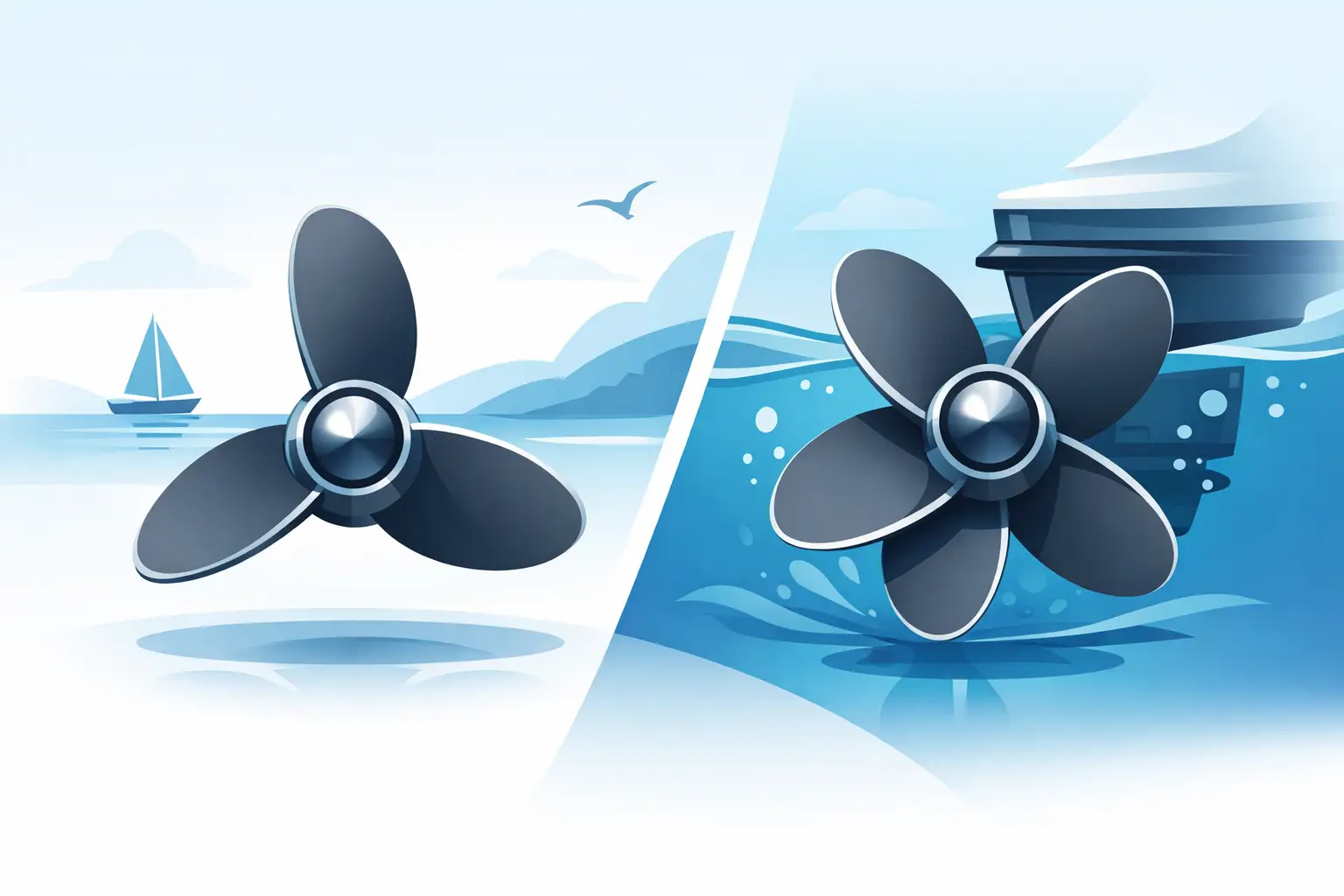
Choosing a 4-Blade or 3-Blade Propeller
You often only notice it out on the water: the boat is just a bit slow to get on plane, revs too high in turns, or feels unsettled under a heavier load. That's when the question quickly comes up: 4-blade or 3-blade propeller? That's not a minor detail, but a choice that directly affects acceleration, top speed, grip, fuel consumption, and the general handling of your boat.
On MerCruiser drives, we see in practice that many problems aren't caused by the engine or the sterndrive alone, but simply by a propeller that doesn't match the hull, power, and use well. A propeller can look fine on paper, but still be the wrong choice out on the water. That's why it's worth looking beyond just diameter and pitch.
4-blade or 3-blade propeller: what's the real difference?
The basic difference is simple: a 3-blade propeller has three blades, a 4-blade propeller has four. But that extra blade changes more than many boat owners expect. With four blades, you usually get more blade surface in the water. That often gives more grip, a more stable feel, and better control, especially at low to medium speeds.
A 3-blade propeller is traditionally the most commonly chosen version for general recreational boating and speed. It usually runs a bit lighter, delivers a higher top speed in many cases, and is a logical choice if your boat is already well balanced. A 4-blade is often chosen when you want more traction, want to plane faster, or suffer from ventilation in turns or on rougher water.
So it's not that 4-blade is always better or 3-blade is always faster. It depends on what your boat needs and what bothers you while boating.
When a 3-blade propeller is the better choice
For many speedboats and sporty motorboats, a 3-blade propeller is still an excellent baseline. Especially if you mainly boat solo or lightly loaded, trim relatively tight, and enjoy getting maximum top-end speed out of your set-up. A good 3-blade propeller often gives an efficient feel and lets the engine reach its rpm range more easily.
If you have a MerCruiser combination that already planes cleanly, shows little slip, and handles stably through turns, there isn't always a reason to switch to four blades. Especially on boats where top speed matters more than pulling power, 3-blade often remains the logical choice. Think of sporty day use, short runs, and situations where you mainly want to keep the boat light and fast.
There is a downside, though. A 3-blade can be more sensitive to ventilation, especially if the boat is trimmed high, carries a lot of weight at the back, or often runs through sharp turns. With watersports use too, such as towing a tube or a wakeboarder, you sometimes notice the boat needs a bit more time to really come on with power.
When a 4-blade propeller works better
A 4-blade propeller becomes interesting once grip and control matter more than the last few km/h of top speed. In practice, we see many boat owners switch to a 4-blade because they want to get on plane faster, want less trouble with slip, or are looking for a calmer handling feel.
That extra blade generally gives more water displacement and more consistent load. As a result, the boat often feels sturdier when accelerating. In turns too, a 4-blade propeller usually holds on better. That's pleasant for sporty boating, but also for heavier boats, cabin models, or boats regularly used with several people, extra fuel, or equipment on board.
At lower speeds, a 4-blade often gives more control too. You notice that, for example, when manoeuvring, under varying load, or on water where the hull comes loose and drops back quickly. For anyone who regularly boats with skiers, wakeboarders, or a heavy load, that's often more important than a small loss in top speed.
Performance on the water: where do you feel the difference?
You mostly feel the difference between a 4-blade and 3-blade propeller in four areas: acceleration, planing, cornering behaviour, and top speed. With a 4-blade, there's a good chance your boat comes out of the hole faster. The transition to plane often feels shorter and more powerful. With a 3-blade, that response can sometimes feel a bit freer and lighter, but not always as planted on the water.
In turns, you notice the difference even more clearly. A 4-blade usually holds grip better when you steer the boat under load. That reduces the chance of the engine over-revving due to ventilation. With a 3-blade, the boat can feel a bit livelier instead, which some boaters like, but it sometimes requires more tuning.
Top speed is the point where 3-blade often wins. Not always by a lot, but regularly noticeable. If maximum speed is your main priority and the rest of the set-up is correct, a 3-blade usually has the best credentials. If instead you're looking for an all-rounder that lets the boat handle predictably and powerfully, a 4-blade often comes out on top.
Don't just look at the number of blades
The mistake often made is looking only at three or four blades. In reality, pitch, diameter, material, and cup matter just as much. The wrong pitch can cause your engine to run outside the recommended rpm, and in that case, changing the number of blades might improve something, but won't solve the real problem.
A stainless steel propeller also responds differently than an aluminium version. Stainless steel is stiffer, deforms less under load, and often gives tighter performance. Aluminium is more affordable and fine for many applications, but can show its limits sooner under heavy load or higher power outputs. That's why you should always look at the total combination: engine power, gear ratio, hull, load, and intended use.
On MerCruiser installations, the sterndrive matters too. An Alpha One, Bravo, or other configuration doesn't respond identically to the same propeller choice. What works perfectly on one boat can cause the wrong rpm or unsettled handling on a different set-up.
4-blade or 3-blade propeller for different applications
If you mainly boat sportily and light, 3-blade often remains the logical first choice. You generally get the most out of speed and feel a direct response. For a boat mainly used for short, fast runs without heavy load, that's often sufficient.
If you use the boat more as an all-round recreational boat, with a varying number of people on board and sometimes watersports behind the boat, 4-blade often moves to the forefront. The boat planes more easily, holds on better, and feels less sensitive to weight variations.
On heavier motorboats, or boats that struggle to reach proper rpm under load, 4-blade is also often worth considering. Not because it's a miracle cure, but because extra grip makes a real difference there in practice. If instead you have a boat that already revs high and where speed comes first, you'll want to be careful not to unnecessarily give up top-end performance.
How do you choose the right propeller for your boat?
The best approach doesn't start with the number of blades, but with the boat's current behaviour. Does the engine reach the correct full-throttle rpm? How quickly does the boat plane? Do you struggle with slip in turns? Do you mostly boat alone or with a full load? Do you tow watersports or not? Those are the questions that give direction.
If the boat planes too slowly, feels unsettled in turns, or loses a lot of grip, a 4-blade propeller is often a serious candidate. If you're missing nothing except a few extra km/h of top speed, 3-blade may actually suit better. Sometimes the difference is smaller than expected, and the real gain lies in an adjusted pitch within the same propeller type.
That's why practical information matters so much. Engine rpm at full throttle, current propeller size, engine type, drive type, and how you use the boat together give a much more reliable picture than simply asking whether three or four blades is better. Anyone who wants to choose in a targeted way needs to have that information sorted first.
Common misconceptions
A 4-blade propeller doesn't automatically make a boat faster. Often the opposite is true for top speed. A 3-blade also isn't by definition outdated or inferior. It's still the right choice for a great many boats.
Another misconception is that a propeller swap fixes every performance problem. If the engine isn't running well, the trim is off, the hull is fouled, or the sterndrive isn't in order, the result will keep disappointing. A propeller needs to fit a technically healthy set-up.
That's exactly why it pays not to order blindly based on someone else's isolated experience with a different boat. The right choice is always specific to the combination.
Anyone torn between a 4-blade or 3-blade propeller does well to first honestly look at their own boating habits rather than just brochure figures. The propeller that sails most pleasantly on your boat is usually also the choice you'll enjoy most throughout the season.


