

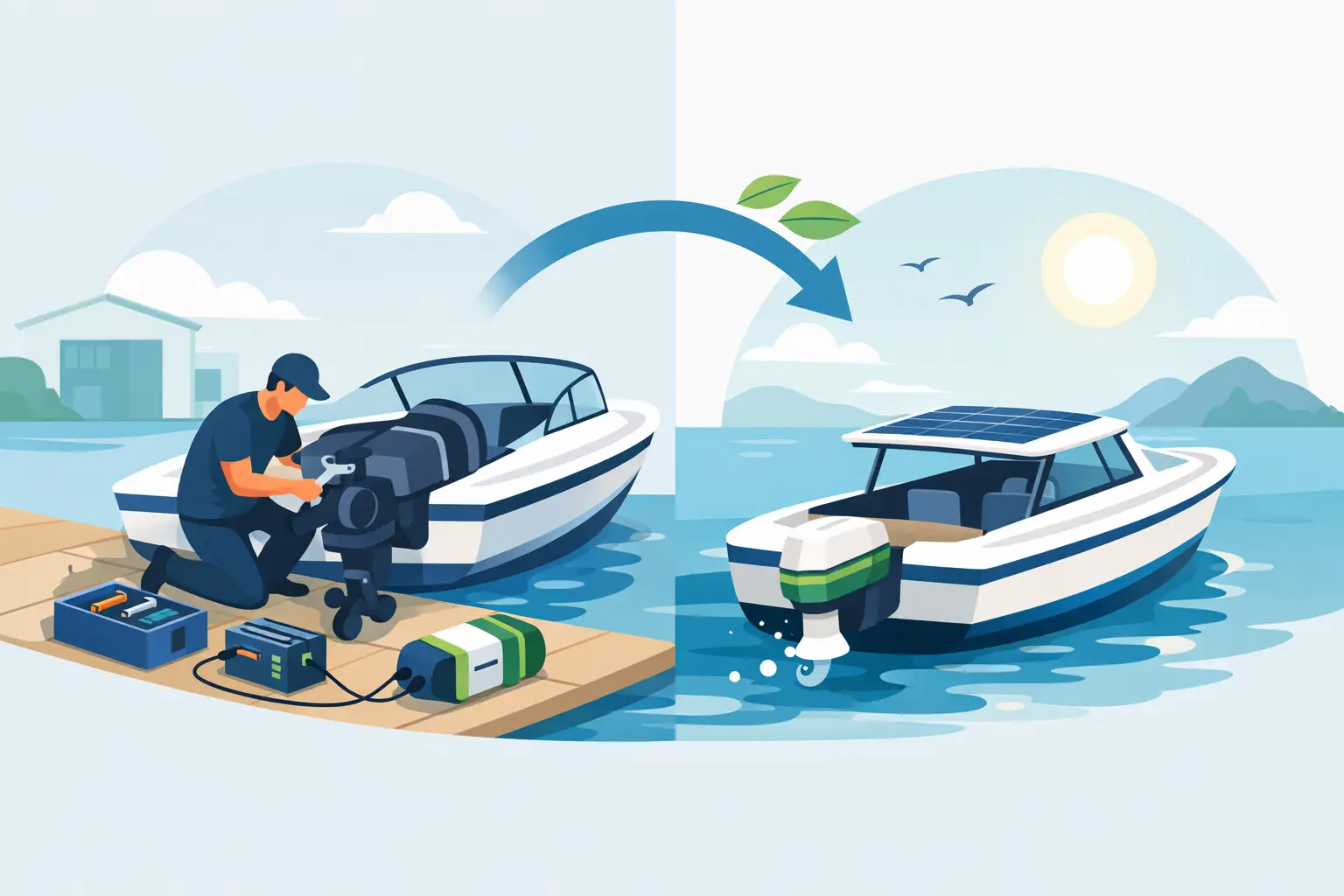
Converting a Boat to Electric Propulsion: How It Works
Converting a boat to electric propulsion is appealing if you want to sail more quietly, reduce maintenance, and no longer have petrol fumes in the engine bay. But on a motorboat, it's not simply a matter of removing the combustion engine and fitting an electric motor in its place. Power, battery capacity, weight, drivetrain, and the actual boating profile all need to align as one system. Especially on a sports boat that previously ran a MerCruiser engine and sterndrive, that preparation determines whether the conversion sails pleasantly or ends in disappointment.
Start with how you actually boat
The most important question isn't how many horsepower your current engine has, but how you use the boat. Do you cruise calmly through canals, on inland water, or take short loops around a harbour area? Then electric boating is often very achievable. Do you cover long distances, tow a water skier, or want a heavier boat to stay on plane for extended periods? Then the required energy quickly adds up.
An electric drive delivers a lot of torque instantly. That feels powerful when getting underway and manoeuvring, but says nothing yet about running time at high speed. A planing hull needs a lot of power to get up and stay on plane. Where calm boating might only demand a few kilowatts, planing can demand tens of kilowatts. The battery doesn't just drain a bit faster then, but often many times faster.
So first put together a realistic usage profile. Think about your desired cruising speed, maximum speed, the number of boating hours between charges, the number of passengers, and the waters you sail on. Anyone mainly wanting two hours of calm cruising chooses a very different installation than someone wanting to keep a speedboat's performance intact.
Converting a boat to electric propulsion: determining the power
For an existing motorboat, the required power is preferably not chosen based on the old engine's horsepower alone. Replacing a 220 hp petrol V6 one-to-one with an electric motor of the same number usually isn't a meaningful approach. Horsepower, torque, rpm range, gear reduction, and propeller load all differ too much.
Look at the hull shape and at the speed you actually need. A displacement launch or cabin boat can already sail comfortably with relatively limited power. A light speedboat with a planing hull needs a drive that delivers enough continuous power to get up to speed. Peak power is useful there, but continuous power determines how long the installation can safely deliver that performance.
The propeller deserves just as much attention as the motor. An electric motor works efficiently in a different rpm range than a combustion engine. Sometimes the existing gearing and propeller still fit well enough, but often a different pitch, diameter, or gear ratio is needed. A propeller that's too heavy places unnecessary strain on the motor and controller. A propeller that's too light gives high rpm without the desired thrust.
On a sterndrive, the existing drivetrain can sometimes be retained, but this needs to be technically assessed. The condition of the drive, the gearing, the coupling with the electric motor, and the available space are all decisive. An electric drive delivers torque instantly, which can bring wear or play in an older drive to light faster. So check not just the engine bay, but also the bellows, U-joints, bearings, oil, trim, and the complete sterndrive construction.
Calculating batteries: kWh matters more than Ah
The battery bank determines your range, weight, and budget. So compare systems in kilowatt-hours (kWh), not just amp-hours (Ah). The number of Ah says little without voltage. A 200 Ah battery at 48 volts, for example, contains far more energy than a 200 Ah battery at 12 volts.
The basic calculation is simple: divide the usable battery capacity by the average consumption in kW. With 20 kWh of usable energy and an average consumption of 5 kW, the theoretical running time is four hours. In practice, you keep a reserve for wind, current, manoeuvring, battery ageing, and an unexpectedly longer trip back. So don't count on the last few percent of the battery bank.
Lithium iron phosphate batteries are often chosen for their usable capacity, long lifespan, and relatively low weight. Still, it's not just the cells that matter. A battery pack needs to be fitted with a suitable battery management system, main fuses, a service disconnect, contactors, correct wiring, and a safe main switch. At higher voltages, insulation, shielding, and expert installation matter even more.
Position the battery bank low in the boat, as close as possible to the original centre of gravity. Removing a heavy petrol engine and fuel tank significantly changes the weight distribution. Batteries in the wrong place can leave a boat sitting stern-heavy, struggling to plane, or steering unevenly. The battery box also needs to be protected against moisture, vibration, and mechanical damage.
Choose a charging solution that fits your mooring
An electric boat only becomes practical once charging fits your permanent mooring and boating rhythm. For calm use, charging at the dock after every day out is often sufficient. For more intensive use, you may need a more powerful shore power charger, an extra charging point, or a second battery bank.
Check beforehand what the shore power supply can actually deliver. A charger that's too powerful for a limited socket causes faults or overload. The charger also needs to match the battery voltage and battery technology. Also think about the 12V onboard supply for lighting, the bilge pump, VHF, and accessories. That can be fed via a separate service battery or a properly regulated DC-DC converter.
Solar panels can partly cover the consumption of onboard equipment and are useful for maintenance charging. On a motorboat, though, don't expect panels to supply the energy needed for prolonged or fast boating. Available surface area is limited and propulsion demands a lot of power. So see solar power as a supplement, not the main charging source.
Don't forget cooling, safety, and controls
A combustion engine and all its associated parts don't simply disappear without consequences. The fuel tank, exhaust, cooling water connection, ventilation, controls, and instruments all need to be reassessed. Some parts become redundant after a conversion, others remain necessary or take on a different function.
The electric motor and motor controller may need cooling. Depending on the system, that happens via air cooling, a closed cooling circuit, or water cooling. Don't reuse old hoses, pass-throughs, or connections without checking them. A small leak in the engine bay is a risk you need to rule out beforehand with high-voltage components involved.
Controls also need to be logical and reliable. A clear main switch, emergency stop, forward-neutral-reverse control, charge status, and fault indication all belong within easy reach. Make sure everyone who uses the boat knows how to de-energise the system. Document cable routes, fuses, and component numbers for future maintenance or troubleshooting.
A proper installation isn't just neatly finished. Cable cross-sections need to match the current, connections need to be protected against corrosion, and all pass-throughs need to be vibration-resistant. If in doubt, measuring and assessing beats assuming. That prevents a breakdown on a beautiful day out and limits the risk of costly damage.
What does an electric conversion cost?
Costs depend heavily on the desired performance. For a calm launch, the installation is more straightforward than for a planing motorboat with a large battery bank. The main cost items are usually the electric motor, controller, batteries, charger, wiring, mounting parts, any drivetrain adjustments, and labour.
Don't cut corners on safety or on components that are hard to reach after installation. A cheap battery without clear specifications, insufficient peak current, or limited support can make the entire conversion unnecessarily fragile. On the other hand, the most expensive motor isn't automatically the best choice. A well-matched system suited to your hull and use is more valuable than excess capacity you rarely use.
With an existing sterndrive, it's wise to first determine which parts can be reused and which need overhauling first. Overhauling the drive during the conversion can be cheaper than disassembling it again later. For parts, technical assessment, or a quote for an electric conversion, you can contact MerCruiser-Onderdelen.com directly.
DIY conversion or have it done?
A handy boat owner can do a lot of the preparatory work themselves, such as removing old components, cleaning the engine bay, and restoring non-structural parts. The electrical installation, the motor coupling, and the final check, though, require specific knowledge. Especially with higher-voltage systems, working safely isn't something you want to experiment with.
Only choose a full DIY build if you can read schematics, make cable calculations, and know how to test the installation. Otherwise, at least have the design, the critical connections, and the first test run checked. That gives clarity on loads, temperature, battery voltage, and how the drive performs under real-world conditions.
A successful electric conversion starts with honest expectations: calm, quiet, low-maintenance boating is often very achievable, while prolonged fast boating demands a much bigger and more expensive energy supply. Anyone who first has their boating habits and existing drivetrain properly assessed makes choices they'll still enjoy after several seasons.


