

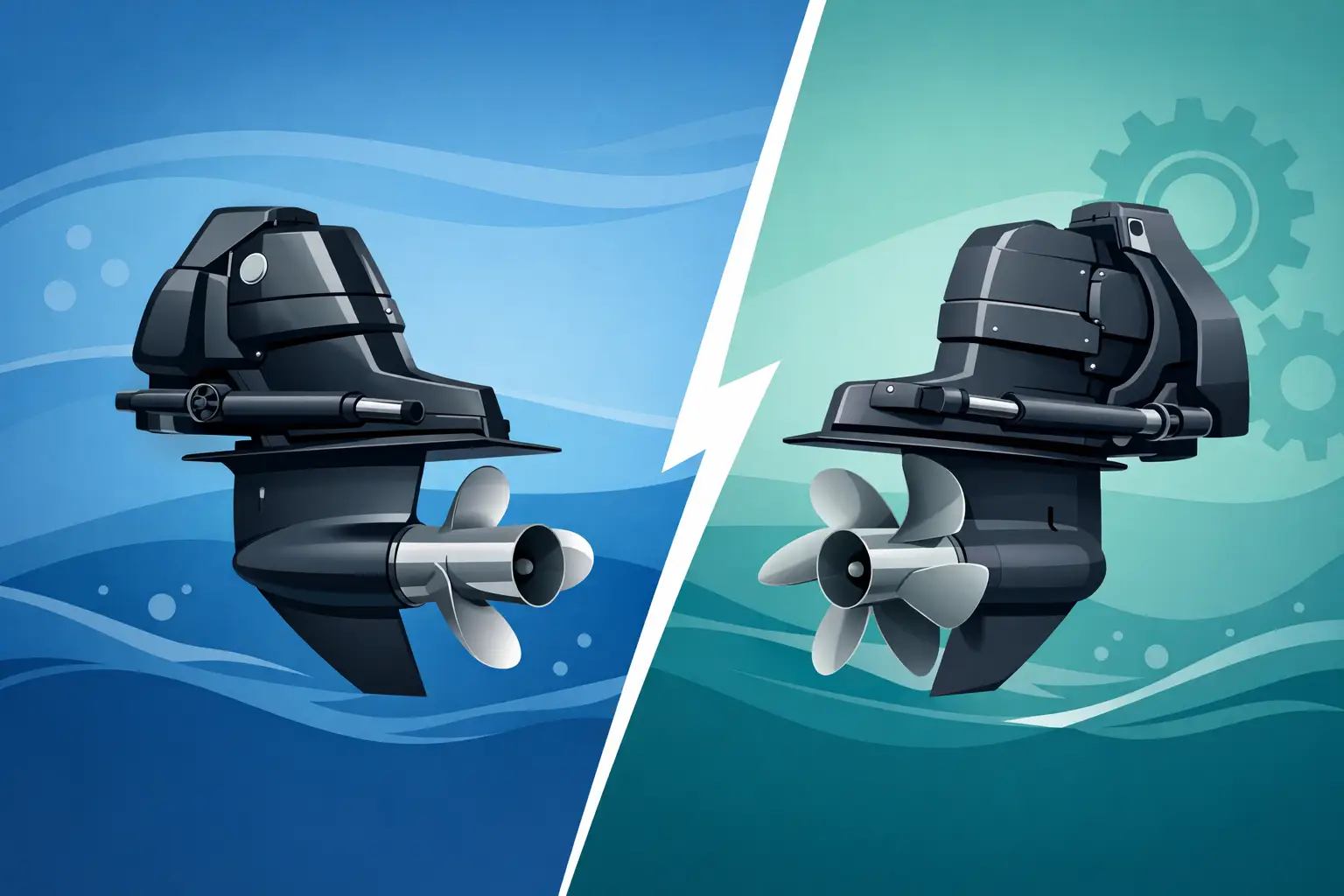
Alpha One vs Bravo Drive: Which Fits Your Boat?
Anyone with a MerCruiser boat looking for parts eventually runs into the same question: Alpha One versus Bravo drive. On paper it looks mainly like a choice between two sterndrives, but in practice that choice determines how much power you can safely handle, how often you need maintenance, and which parts need to be available later without hassle.
For many boat owners, this isn't a theoretical comparison. It usually only really matters once a drive wears out, a complete replacement is needed, or someone is considering an engine conversion. That's when you quickly notice that Alpha One and Bravo aren't simply interchangeable systems. Each has its own operating range, its own strengths, and its own limitations.
Alpha One versus Bravo drive: where's the real difference?
The main difference lies in the load the drive can handle. An Alpha One is developed for lighter to medium-heavy applications. Think of many sports boats and motorboats with moderate power and normal recreational use. A Bravo drive is built for heavier engine configurations, more torque, and heavier load over longer periods.
You notice that difference not just at full throttle. It also comes into play when accelerating, boating with a heavy load, towing water skiers or wakeboarders, and prolonged cruising at higher speed. A Bravo often feels calmer and stronger in those situations, simply because the drive has more reserve capacity.
That doesn't automatically mean Bravo is always better. An Alpha One is lighter, simpler, and more than sufficient for many boats. Anyone with a well-matched engine power output and no extreme load demands can get by perfectly well with an Alpha. In fact, in many cases an Alpha One is simply the more economical choice.
When does an Alpha One fit better?
An Alpha One usually fits well with smaller and medium-sized petrol engines used recreationally. If you mainly go on day trips, occasionally boat more sportily, and don't have a heavily tuned V8 out back, an Alpha is often more than enough. The system is widely used, parts are familiar to mechanics, and many owners know the basics of servicing and winterizing it.
Alpha is also often more attractive cost-wise. Not just the purchase price, but also many common parts such as bellows, water pump components, seals, and service kits are usually in an accessible price range. For owners who want to stay on top of maintenance without buying unnecessarily heavy-duty equipment, that's a real advantage.
There is a clear limit here, though. As soon as power and torque increase, or a boat is used structurally hard, you quickly enter the zone where an Alpha has to work harder than is ideal. Then cheap in the short term sometimes becomes more expensive in the long run.
The practical advantages of Alpha One
What many owners appreciate about the Alpha One is its simplicity. The drive is relatively straightforward, many maintenance points are well known, and for standard use it's a proven system. That's convenient for parts supply and service, since you can usually move quickly.
There's also a lot of knowledge available in the market. That often makes diagnosis easier. Especially on older boats, that's welcome, since you don't have to start a specialist search for every standard part.
When is a Bravo drive the better choice?
A Bravo drive comes into the picture as soon as power increases or use becomes heavier. With V8 engines, sportier boating, heavier hulls, and applications that demand a lot of pulling power, Bravo simply offers more certainty. The construction is more robust and designed to absorb more load.
You see that reflected in durability, provided the drive is well maintained. Under the right conditions, a Bravo can keep functioning properly for longer where a lighter drive would already be nearing its limit. That's an important point especially for boat owners who want to combine performance with reliability.
On the other hand, Bravo is usually more expensive to buy, and for some repairs also in parts and labour. So it's not just a technical choice, but also a usage choice. Anyone who doesn't need the extra capacity doesn't need to pay for it either.
Bravo isn't always the smartest investment
In practice, we regularly see owners assuming heavier is automatically better. That's not always true. A Bravo on a boat that's mainly used for calm recreational boating with modest engine power doesn't necessarily deliver an advantage that justifies the extra cost. You end up buying reserve capacity you may never use.
The reverse, under-sizing, is genuinely risky. A boat with serious power on a drive that isn't really intended for it often leads to recurring costs. Then you end up further from a solution than before.
Maintenance and parts: what should you pay attention to?
With Alpha One versus Bravo drive, maintenance is an important deciding factor. Both systems need regular maintenance on oil, bellows, bearings, water pump components, anodes, and seals. Still, the load differs per application, and so does the risk of wear.
An Alpha One that runs neatly within its intended application can stay reliable for years. But as soon as the drive is structurally loaded heavily, wear shows up sooner in bearings, gears, or couplings. With Bravo that threshold is higher, but even there, deferred maintenance can turn out expensive.
For parts, it's crucial that you know exactly which type and model year you have. Within Alpha One and Bravo there are different versions, generations, and detail differences. A wrong bellows, an incorrect bearing, or a water pump kit that doesn't fit costs time, money, and, especially during the season, frustration.
That's why it's smart not to order based on model name alone, but also on serial number or exact identification of the drive. Especially with second-hand boats, converted combinations, or older MerCruiser installations, otherwise you can quickly run into trouble.
Power, boating style, and boat weight determine the outcome
You don't make the right choice on name alone. You need to look at three things at once: engine power, torque, and how the boat is actually used. A light sports boat with modest engine power asks something completely different of a drive than a heavier cruiser with a lot of load or a sporty V8 combination.
If you mostly boat calmly on inland waters and occasionally go a bit faster, an Alpha One can often perform excellently. If you often boat at high throttle, regularly tow skiers, or have a boat that needs to come out of the water heavily loaded, Bravo quickly becomes the logical choice.
Boat weight is often underestimated here. It's not just the engine that counts, but also the total load of the hull, fuel, passengers, and equipment. A combination that looks acceptable on paper can in practice be structurally heavier than expected.
Converting from Alpha to Bravo - do it or not?
This is a question that often comes up with engine upgrades. In theory, a conversion can make sense, but only if the whole picture fits. You then need to look not just at the drive unit itself, but also at the transom plate, compatibility, gear ratio, alignment, and often additional parts.
So a conversion isn't a standard quick fix. Sometimes it's technically wise and cheaper in the long run than continuing to repair a set-up that's really too light. In other cases, it's actually an expensive route while overhaul or replacement within the same platform makes more sense.
So first establish why you want to convert. Is it because of extra power, recurring damage, poorer availability of certain parts, or simply because a complete set is offered at a good price? Only then can you judge whether Bravo is really the right step.
What's the best choice for most boat owners?
For the average recreational MerCruiser user with normal power, the Alpha One remains a fine and practical drive. Affordable, familiar, and easy to maintain. If the boat and engine match well, there's technically little to argue against it.
For owners with more power, a heavier boat, or a usage profile where the drive really has to work, Bravo is often the wiser route. Not because it sounds more luxurious, but because it better matches the load. That often saves a lot of hassle during the season.
Doubt usually sits in the middle ground. There, the details are decisive: exact engine type, gear ratio, boat weight, propeller choice, and use. It's exactly in that grey area where good advice is more valuable than guessing based on price alone or scattered forum experiences.
Anyone looking for parts or a replacement does well to first have the current system properly identified, and only then determine whether repairing, rebuilding, or switching is the best choice. At mercruiser-onderdelen.com, we regularly see that one correct technical check saves more time and cost than a quick wrong order.
If your boat needs to stay on the water and you don't want a second round of repairs in the middle of the season, don't choose the drive that looks best on paper, choose the drive that truly fits your engine, your hull, and your way of boating.


