

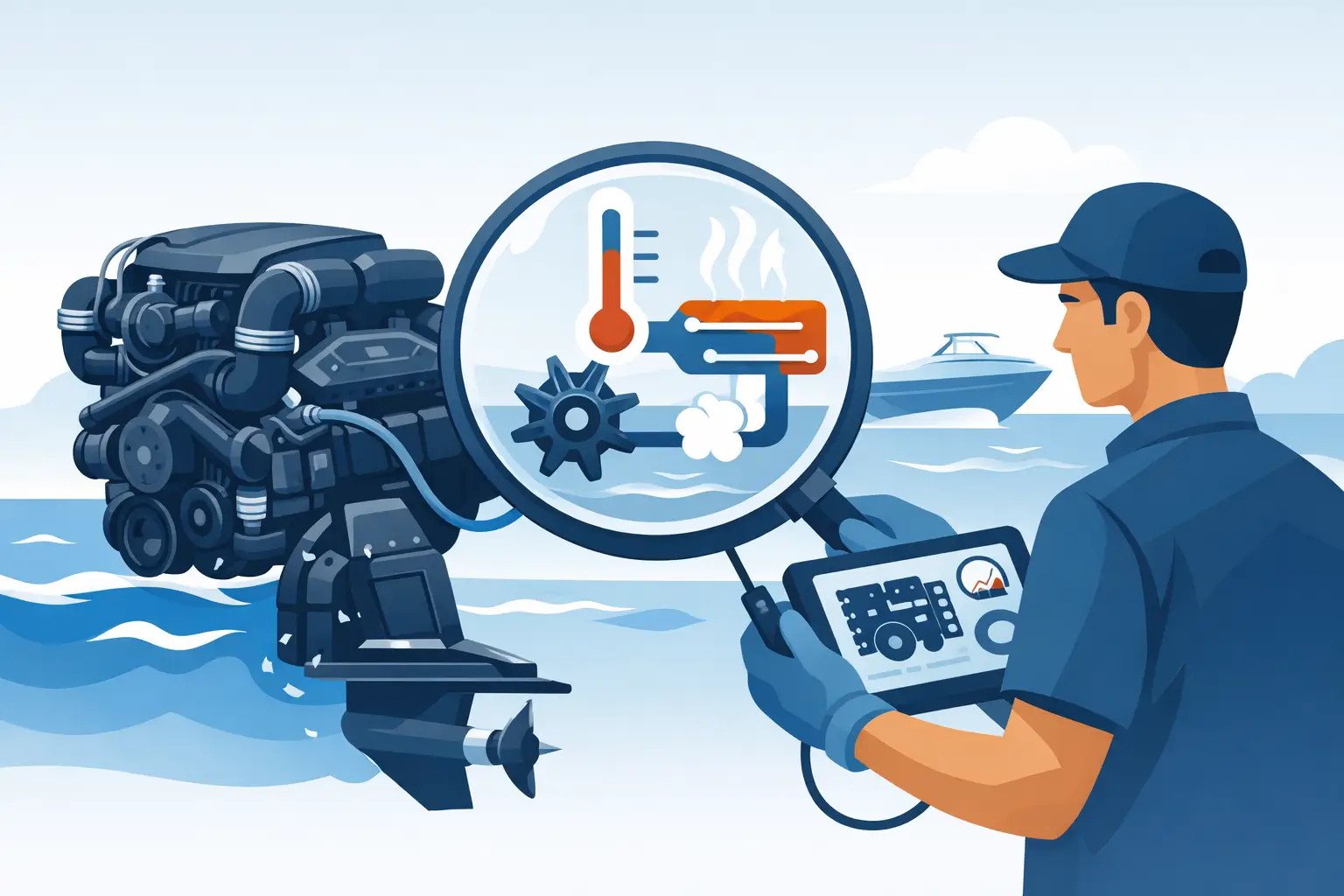
Case Study: Diagnosing a MerCruiser Cooling Problem
A MerCruiser running too hot doesn't call for guesswork, but for a disciplined approach. In this practical case study of diagnosing a MerCruiser cooling problem, we show how to work from complaint to cause without unnecessarily replacing parts. That saves time, prevents extra damage, and, especially during the season, is often the difference between boating or being stuck at the dock.
The complaint was clear: at cruising speed, the engine slowly crept towards too high a temperature, while at idle at the dock the gauge stayed fairly normal. That kind of behaviour rarely points to "just a broken water pump". The difference between idle and load actually says a lot. Under higher load, the entire cooling system has to process more volume. If there's resistance, an air leak, contamination, or a component that doesn't fully open somewhere in that path, the problem often only really shows up once the engine has to work.
Case study: diagnosing a MerCruiser cooling problem on board
In this example, we're dealing with a MerCruiser petrol engine with raw water cooling through the sterndrive. The owner had already replaced the impeller themselves, since that's often mentioned online as the first cause. Understandable, but the problem persisted. We see that more often. A new impeller only fixes something if the fault was actually in the impeller. If the cause lies elsewhere, you haven't made any progress.
The first check therefore didn't start with loose assumptions, but with the basics: is the temperature reading even correct? A faulty sensor, poor earth connection, or unreliable gauge can suggest a cooling problem that doesn't actually exist. That's why it's wise to always compare engine temperature with a second measurement, for example at the thermostat housing and relevant hoses. Only once those values track logically with the dashboard gauge do you move on to searching further in the cooling system itself.
In this case, the temperature really was rising. So no measurement error. Then you look at the route of the coolant from the water intake through to discharge via the exhaust and elbows. Three questions guide that: is enough water coming in, is the water properly routed through the engine, and can it get away freely afterwards?
Step 1 - checking the water supply
Since the impeller had already been replaced, there's a big temptation to skip that part. Still, that's exactly where you need to look again critically. A new impeller in a worn pump housing still gives poor output. The same applies to a damaged wear plate, an incorrectly fitted gasket, or a leak on the suction side. On MerCruiser systems via an Alpha One or Bravo sterndrive, the problem can also lie in the water tube, connection, or water intake openings.
On this engine, we checked the water supply starting from the sterndrive. The intake openings weren't fully blocked, but were partly contaminated with growth and buildup. That alone didn't fully explain the complaint, but it was a first signal. After that, the pump housing was inspected again. The impeller was new, but the housing showed clear signs of wear. As a result, you simply lose output under higher demand. At idle, everything still seems acceptable, but under load you come up short.
Step 2 - thermostat and flow through the engine
Next, the thermostat comes into the picture. A thermostat doesn't have to be fully faulty to still cause problems. If it opens too late or doesn't fully open, you get exactly the kind of complaint at play in this case study. The engine then stays reasonably within range under light load, but runs hotter as soon as more power is demanded.
The thermostat was removed and tested. It did respond, but sluggishly and incompletely. That's a typical grey area. You can argue whether it's "still just about fine", but in practice you don't want to leave questionable components in a cooling system. Certainly not if the boat is used during the season and the owner needs reliability.
At the same time, it's wise not to be satisfied too early. A mediocre thermostat can be part of the problem, but doesn't have to be the only cause. That's why the thermostat housing was also checked for corrosion, buildup, and narrowing of the passages. On older MerCruiser engines, we regularly see internal contamination that reduces flow, even though the hoses still look fine from the outside.
Where this MerCruiser cooling problem diagnosis was really decided
The decisive factor only came once the exhaust side was included in the diagnosis. That happens too rarely in DIY troubleshooting. Many owners look at the impeller, hose, and thermostat, but forget that coolant also needs to get away after the engine, via the manifold, risers, and exhaust elbows. If there's narrowing or corrosion there, the system builds up too much back pressure and heat stays put where you don't want it.
When removing the exhaust elbow, part of the coolant passage turned out to be heavily narrowed by corrosion and buildup. That produced exactly the pattern the owner described. At idle, there was just enough flow. Under higher load, no longer. The temperature then slowly rose, without the engine immediately getting extremely hot. That's what makes this type of fault so deceptive. You don't get an immediate total failure, but a recurring problem that can eventually cause serious engine damage.
The actual cause
The real cause therefore wasn't a single faulty part, but a combination of three factors: a partly contaminated water intake, wear in the pump housing, and narrowing in the exhaust elbow, along with a thermostat that also wasn't fresh anymore. That's exactly why proper diagnosis matters more than randomly replacing parts. If you'd only fitted a new thermostat here, the complaint would likely have come back. If you'd only replaced the impeller again, the same would apply.
After replacing the worn and narrowed components and checking the entire water route, the temperature stayed stable again, both at idle and under load. Only then can you say the repair succeeded.
What you can learn from this for your own MerCruiser
A cooling problem is rarely just a matter of glancing at the temperature gauge and ordering the first part that comes to mind. The system consists of several links that influence each other. The skill lies in testing logically rather than working on gut feeling.
Always start with the description of the complaint. Does the engine only run hot under load, specifically at idle, or right from a cold start? Only running hot under load points more often to insufficient flow or a restriction further down the system. Problems specifically at idle can point more towards circulation or the internal side of the engine. Hot right from the start can point more towards the thermostat, a measurement error, or serious flow problems.
Then look at the maintenance history. Has the impeller been recently replaced, how old are the manifolds and elbows, has the boat been used in salt or fresh water, and have there been previous heat complaints? Especially with saltwater use, you need to be extra alert to internal corrosion in exhaust parts. That's where a lot goes wrong, even on engines that otherwise run smoothly.
A second lesson from this case study of diagnosing a MerCruiser cooling problem is that aftermarket and original both have their place, but the choice differs per part. For some components, a good replacement part is fine. For critical cooling parts, you especially want certainty about fit, material, and flow. Wrong tolerances or poorer finishing can cost you time again later.
Parts often involved
With MerCruiser cooling problems, in practice we often end up at the impeller, pump housing, wear plate, thermostat, thermostat housing, hoses, water tube, transom connections, manifolds, and exhaust elbows. Sometimes it's a combination. Sometimes an installation error turns out to be the culprit, for example a gasket fitted the wrong way round or a seal that's drawing air. That's why experience helps. Not because every problem is the same, but because certain patterns keep recurring.
For owners who work on their own boat, the same advice applies as in the workshop: don't replace blindly, but check how things interconnect. A new impeller in a damaged pump housing is only half the job. A new thermostat with clogged exhaust passages is too. And ignoring a temperature problem because the engine "still runs" is asking for more expensive damage.
When to do it yourself and when to get help
You can perfectly well carry out many checks yourself if you're technically minded and have the exact engine type clearly identified. Think of visual inspection, checking hoses, removing the thermostat, and inspecting water intakes. But as soon as you're unsure about the flow direction, part choice, or the combination of engine and sterndrive, it's smarter to consult in a targeted way. Especially with MerCruiser, the exact model matters a great deal for the correct parts and system build-up.
At mercruiser-onderdelen.com, we see every day that customers get stuck on the last 20 percent of the diagnosis. The complaint is clear, but the real cause isn't. In that case, it's often more efficient to have someone take a technical look and select the right components straight away, rather than replacing something that doesn't solve the problem three times in a row.
A cooling problem punishes delay hard. If your temperature gauge shows unusual behaviour, the engine gets hotter under load, or you suspect a restriction in the water flow, don't wait until the next day out on the water. Good diagnosis starts with looking calmly, testing logically, and only replacing what you can actually justify.


