

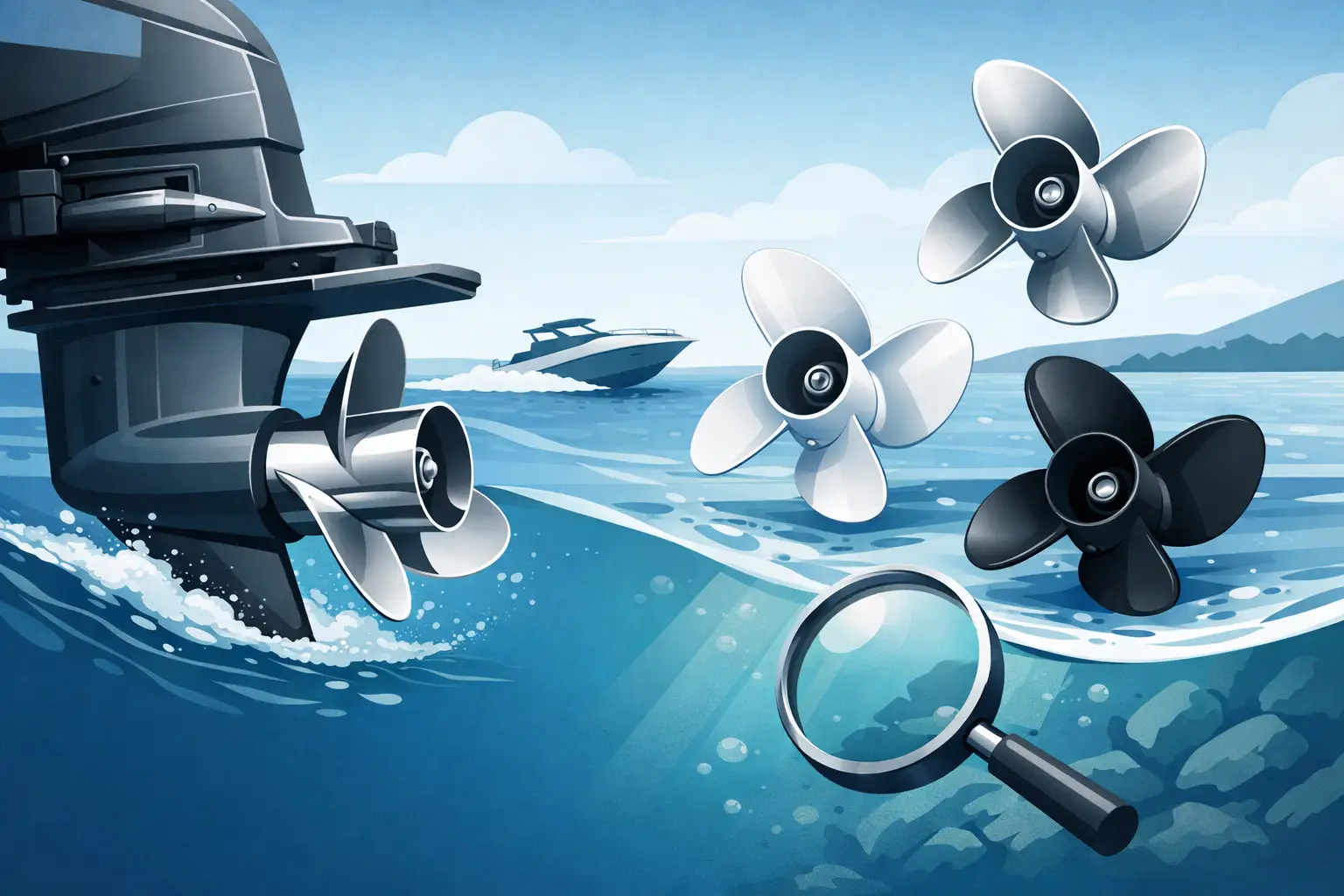
Choosing a MerCruiser Propeller Without Guesswork
Anyone who chooses a MerCruiser propeller by feel is often disappointed the moment the boat is fully loaded, planes poorly, or just doesn't reach the right rpm. The right propeller determines how your boat accelerates, steers, cruises, and how much load your engine carries. That's why you shouldn't just look at diameter or pitch, but always at the combination of engine, drive unit, boat type, and use.
Why the right propeller is more than just size
Many boat owners search first by horsepower or by the old part number. That's understandable, but not enough. A propeller that fits on paper can still be wrong in practice if the boat is now used differently, carries a heavier load, or has a different set-up than originally.
With MerCruiser, it also matters which drive unit you have, for example Alpha One or Bravo, and which gear ratio goes with it. It also makes a difference whether you mainly cruise gently, tow watersports, want to plane quickly, or are after top speed. The best propeller for a sports boat with a light load is often not the same as for that same boat with family, a full tank, and gear on board.
Choosing a MerCruiser propeller based on rpm
The most important check is simple: does the engine reach the prescribed maximum rpm from MerCruiser's specifications at full throttle? That's almost always where good propeller advice starts.
If the engine doesn't reach that rpm, the propeller is usually too heavy. The engine then has to work too hard. You'll notice that through sluggish acceleration, difficulty planing, and a boat that feels sluggish at low speed. In the longer term, that's also not an ideal load for the drivetrain.
If the engine revs too high instead, the propeller is often too light. The boat may feel lively, but you're leaving efficiency and grip on the table. Top speed can also disappoint because the engine spins too easily without putting the right thrust into the water.
A practical rule of thumb is that a change of 1 inch of pitch usually changes engine rpm by roughly 150 to 200 rpm. That's not a hard rule, hull, weight, and propeller type all play a role, but it's a useful starting point.
What does pitch mean in practice?
Pitch determines how far a propeller theoretically travels per revolution. A higher pitch often gives more potential for speed but also demands more from the engine. A lower pitch helps with quicker pickup, easier planing, and better performance under load.
If you use the boat for water skiing or wakeboarding, slightly less pitch is often smarter than choosing purely for top speed. If you mainly cover long distances with a light load, a higher pitch can be a good fit, provided the engine stays neatly within its rpm range.
Diameter isn't simply interchangeable
Diameter and pitch work together. A larger diameter can give extra grip and load-carrying capacity, but has to fit the engine, gear ratio, and the space available around the drive unit. That's why switching blindly to a bigger model is rarely wise. Especially with MerCruiser installations, you need to check what technically fits your drive and what actually works well under your boat.
Aluminium or stainless steel?
For many recreational users, aluminium is a perfectly good choice. It's more affordably priced, widely available, and often more than sufficient for normal use. Especially if you don't have extreme performance demands, a good aluminium propeller is a logical and practical solution.
Stainless steel offers advantages if you're after more grip, sharper response, and often better performance. The material flexes less, so the propeller keeps working more tightly under load. You'll notice that mainly in acceleration, cornering behaviour, and load at higher speeds. On the other hand, stainless steel is more expensive, and a hard impact against an obstacle is less likely to be absorbed by the propeller itself.
So the choice depends on how you use the boat. For a lot of day-to-day recreational use, aluminium is sensible. For sportier use, heavier boats, or owners who really want to fine-tune their set-up, stainless steel is often the better step.
Number of blades and boat behaviour
A 3-blade propeller is often the standard choice because it gives a good balance between speed and general usability. For many MerCruiser boats, this works well, especially if you want an all-round set-up without specialist demands.
A 4-blade propeller often gives more grip, more stable planing, and better behaviour at lower speeds or with a heavier load. That's interesting for boats that need to get up on plane quickly, for towing use, or for skippers who want more control than absolute top speed.
The downside is that you sometimes give up a bit of top-end speed. That doesn't have to be a problem if the boat actually becomes more pleasant and usable in practice. This is exactly the point where propeller choice remains a matter of fine-tuning: faster on paper isn't always better on the water.
Look beyond just the old propeller
Many people simply reorder whatever is currently fitted. That only works if the current propeller is actually the right one. In practice we regularly see boats with the wrong pitch, a damaged model that was once fitted as a temporary fix, or a propeller that was originally chosen for a different purpose.
That's why it's smart to gather a few basic details: engine type, horsepower, maximum rpm, drive unit type, current propeller size, current full-throttle rpm, and how the boat currently behaves. With that information, you can determine much more precisely whether you need the same size or should step up or down in pitch.
Common mistakes when choosing a MerCruiser propeller
The first mistake is choosing based on top speed alone. That sounds appealing, but if it makes the boat plane slowly or overloads the engine, you don't gain much. The second mistake is not taking load into account. A boat that runs well solo can react completely differently with extra passengers and a full tank.
A third mistake is not checking hub compatibility. Not every propeller that looks interesting in terms of size actually fits your MerCruiser drive. Finally, damage is often underestimated. A slightly bent blade or a damaged edge can already have a noticeable effect on vibration, performance, and fuel consumption.
When should you switch propellers?
Sometimes the need is obvious, for example with visible damage or vibration. But switching can also make sense without damage. If your boat has trouble planing, lacks pulling power, doesn't reach the right rpm, or feels unsettled in turns, the propeller is a logical factor to assess.
It's also smart to reconsider after changes to the set-up. Think of extra weight on board, a different engine build, a different boating area, or a different intended use. A propeller that used to be right may no longer be so.
How to approach it in practice
Start with the details of your current set-up, and don't just measure what's stamped on the propeller, but above all look at how the boat behaves on the water. Note the full-throttle rpm with a normal load, how quickly the boat planes, whether there's slip in turns, and whether you're mainly lacking power or speed.
From there you determine the direction. If the engine's rpm is too low, you generally look at less pitch. If it revs too high, you look at more pitch. If you want more grip and control, a different blade design or a 4-blade model may suit better. If you want an affordable replacement for normal recreational use, aluminium is often the logical choice. If you want sharper performance, stainless steel comes into the picture sooner.
If in doubt, it's wiser to ask for advice than to order twice. Especially with MerCruiser installations, it pays to have a specialist look at the engine, drive, and intended use together with you. That prevents downtime during the season and often saves more than it costs. At mercruiser-onderdelen.com, we help with that in practice every day, precisely because the right propeller is rarely a standalone part and is almost always part of the whole set-up.
The best choice is the propeller that suits your boat
So there isn't one single best MerCruiser propeller for everyone. The right choice depends on your engine, drive unit, hull, load, and expectations on the water. Anyone who takes that seriously ends up with a boat that comes out of the hole better, sits on rpm more cleanly, and simply handles more pleasantly all round.
If you're unsure between two sizes, or want to know whether aluminium is sufficient or stainless steel offers real added value, gather your engine details and current propeller size and have it looked at, that's usually the fastest route to a boat that simply runs well.


