

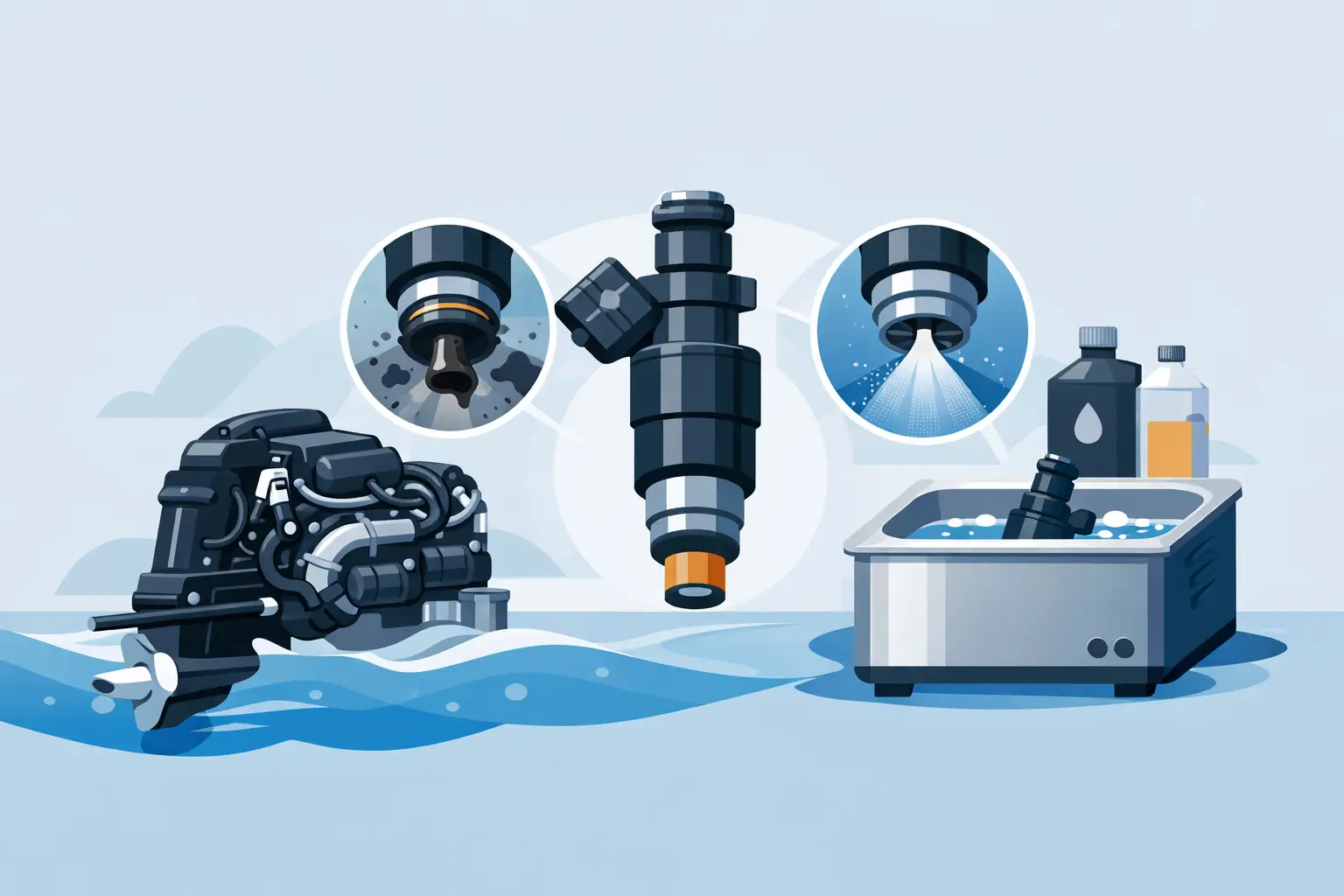
Cleaning a MerCruiser Fuel Injector Explained
A MerCruiser that picks up poorly under throttle, idles unevenly, or uses more fuel than normal doesn't always point straight to the injector. Still, contamination in the fuel system comes up remarkably often, especially on boats that have sat idle for a while. Anyone searching for how to clean a MerCruiser fuel injector usually isn't after theory, but a solution that quickly clarifies whether cleaning will help or something else is going on.
On a boat engine, that distinction matters. A car with light loads can often keep running reasonably well with a mediocre spray pattern. On the water, you notice power loss, poor starting, or hesitation under load much sooner. On top of that, you don't want to replace parts on guesswork during the season. Assess properly first, then clean, test, or replace.
When cleaning a MerCruiser fuel injector really helps
An injector doesn't always get contaminated in the same way. Sometimes it's light deposits from aged fuel. Sometimes it's resin formation after winter storage. And in other cases the injector is electrically or mechanically faulty, in which case cleaning does little good.
Cleaning is especially useful if the injector still works but no longer meters fuel optimally. You'll notice that, for example, through difficulty starting after standing still, uneven idling, fluctuating rpm, or an engine that briefly hesitates during acceleration. A cylinder that occasionally drops out can also be caused by a contaminated injector, though you should include ignition, compression, and fuel pressure in the diagnosis as well.
On MerCruiser MPI and EFI systems, we regularly see injectors getting contaminated from old fuel, moisture in the system, or contamination from the tank and lines. Especially on boats used seasonally, that's not unusual. Cleaning an injector without addressing the cause then often only helps temporarily.
First properly separate the complaints
Not every fuel complaint means the injectors are contaminated. A weak fuel pump, a clogged fuel filter, a leaking pressure regulator, a poor earth connection, a coil problem, or a contaminated IAC valve can produce similar symptoms. That's why blindly starting with cleaning a MerCruiser fuel injector isn't always the fastest route.
In practical terms, a good check starts with the fault pattern. Does the engine start poorly cold, warm, or always? Does it only run poorly at idle, or also under load? Did the problem develop gradually or appear suddenly? Those questions determine whether you should lean towards contamination or a fault.
On an engine that's been sitting for months and then runs badly, contamination is more likely. On an engine that suddenly runs on one cylinder less, you should think sooner of an injector that's not being triggered at all, a connector problem, or an ignition fault. That distinction saves time and parts.
How contaminated injectors behave on a MerCruiser
An injector needs to deliver fuel at the correct pressure and with an even spray pattern. As soon as atomisation gets worse, combustion changes. At low load, you'll notice that as shaking or an unsettled idle. Under higher load, the engine can feel flat or even hesitate.
On V6 and V8 MerCruiser engines, a mild deviation sometimes goes unnoticed for longer, because the engine still runs reasonably smoothly overall. But total power, fuel consumption, and starting behaviour do suffer. On 4-cylinder engines, a deviating injector is usually felt more directly.
An extra point of attention is that marine use is different from road use. Moisture, temperature swings, and longer periods of inactivity make fuel systems more prone to deposits. Especially with modern petrol and ethanol content, that can cause problems faster than many owners expect.
Clean it yourself or have it professionally tested
There are roughly three levels. You can use an additive in the fuel, you can remove the injectors and have them externally cleaned and tested, or you can replace them directly. Which route makes sense depends on the severity of the complaint.
A cleaning additive in the tank can be useful for light contamination and preventive maintenance, but don't expect miracles from it if an injector is genuinely clogged or has an abnormal spray pattern. It's a mild first step, not a conclusive diagnosis.
Professional cleaning is technically the better approach when you suspect the injectors are contaminated but still salvageable. In that case they're usually cleaned ultrasonically, tested for flow, checked for leakage, and compared under equal conditions. That immediately shows whether one injector deviates from the rest.
Replacement is often the wiser choice if the injector no longer switches properly electrically, leaks internally, sticks mechanically, or still falls outside specification after cleaning. In that case, cleaning is just buying time.
Approaching MerCruiser fuel injector cleaning step by step
Anyone working on this themselves does well to work in a structured way. Don't start removing parts before the basics have been checked. First check fuel quality, filters, voltage, connectors, and whether the engine faults consistently return on the same cylinder.
After that, you can inspect the injector rail and injectors, depending on the exact MerCruiser engine type. Always work safely. Fuel pressure needs to be properly released and ignition sources need to be kept clear. Use new O-rings when injectors are removed. Reusing old O-rings too often causes leakage problems.
If you have the injectors cleaned, note beforehand which cylinder each injector came from. With per-injector test results, you can then see whether a specific problem moves with the injector or stays with the cylinder. That helps with further diagnosis.
After reinstallation, it's important to check the system for leaks before putting the engine under load. An engine that still runs poorly afterwards may have a broader problem in the fuel supply, ignition, or engine management.
What often goes wrong with injector problems
The biggest mistake is replacing parts too quickly without diagnosis. First the injector, then the pump, then sensors, and the problem ultimately turns out to be contaminated fuel or a poor connector. Especially on seasonal boats, we see that more often than necessary.
A second mistake is only addressing the injectors while the tank, filter, and lines remain contaminated. Deposits then simply come back. If there's rust, sludge, or old fuel residue in the system, you need to look more broadly than just cleaning the fuel injector.
The importance of the right parts is also sometimes underestimated. Injectors need to match the engine management and engine configuration. Universal parts sometimes seem cheaper, but the wrong flow rate or connector type causes more problems than it solves.
Cleaning or replacing - what's the best choice?
That depends on age, test results, and availability. For good-quality original injectors that are only contaminated, cleaning is often a fine solution. Especially if flow rate lines up evenly again after testing and the spray pattern is good.
For older injectors with clear wear, leakage, or an electrical deviation, replacing is usually the safer choice. On the water, you want reliability. An injector that seems just about acceptable on the workbench can still cause problems under real-world conditions.
Price naturally plays a role too. Cleaning is often cheaper than replacing a complete set, but not if you have to remove them again later anyway. So the starting point stays simple: test where possible first, then decide.
Prevention is cheaper than repair
Injector contamination often builds up slowly. That's exactly why prevention pays off. Fresh fuel, timely filter replacement, a proper winterisation procedure, and not leaving old petrol sitting for months all make a noticeable difference. On boats that run few hours but sit idle for long periods, that's even more important than for intensively used engines.
Also don't use random parts in the fuel path. A mediocre-quality filter or hoses that degrade internally can cause fresh contamination. Anyone who maintains their MerCruiser properly by subsystem prevents a relatively small fuel problem from turning into rough running, higher consumption, or unnecessary downtime during the season.
For owners unsure whether to clean, test, or replace, one practical rule is usually enough: if the complaint is mild and appeared after a period of inactivity, start with fuel quality and diagnosis. If the injector demonstrably deviates, have it professionally assessed or replace it directly with a matching part. At mercruiser-onderdelen.com, we see in practice that this approach works fastest and leads to the fewest wrong costs.
Anyone who wants to do it properly treats the injector not as a standalone part but as part of the entire fuel system. That way, your MerCruiser doesn't just keep running better, but above all you prevent a small complaint from growing into lost days on the water.


