

How to Recognize Water in Gasoline
You often notice water in gasoline faster out on the water than in the workshop. The engine starts poorly, drops out under throttle, or suddenly runs unevenly while it ran perfectly fine last time. Anyone wondering how to recognize water in gasoline should above all look at a combination of complaints, since a single symptom often doesn't tell you enough on its own.
For boat engines, this is extra relevant. An engine stalling on the trailer is annoying, but an engine cutting out on open water or while manoeuvring in the marina is a different story. That's why it's smart to look not just at the fuel itself, but also at what the engine is doing, how the fuel system is built, and where the water could be coming from.
How do you recognize water in gasoline from engine behaviour?
The most common clue is uneven running. The engine may start normally at first and then begin to hesitate, especially when accelerating or under load. That's because water doesn't burn like petrol. As soon as the mixture at the fuel intake or in the carburettor or injection system is partly water, the engine no longer gets stable combustion.
On MerCruiser engines and other petrol inboards, you often see a pattern. Idling still seems somewhat acceptable, but as soon as you want to go forward and the engine demands more fuel, it starts to hesitate. Sometimes you also hear small interruptions in rpm, as if the engine keeps skipping a fraction each time.
A second sign is difficulty starting after standing still. Water sinks to the bottom of the tank, since it's heavier than petrol. The fuel pickup therefore often draws from the bottom part of the tank first. If there's water in the tank, the engine gets served the worst part of the contents right at the first start attempt.
Sudden stalling without a clear other cause also fits with water contamination. That's especially true if ignition, battery, and air supply seem fine. If the engine runs briefly and then cuts out, there's a chance water is moving through the system in slugs.
What do you see in the fuel itself?
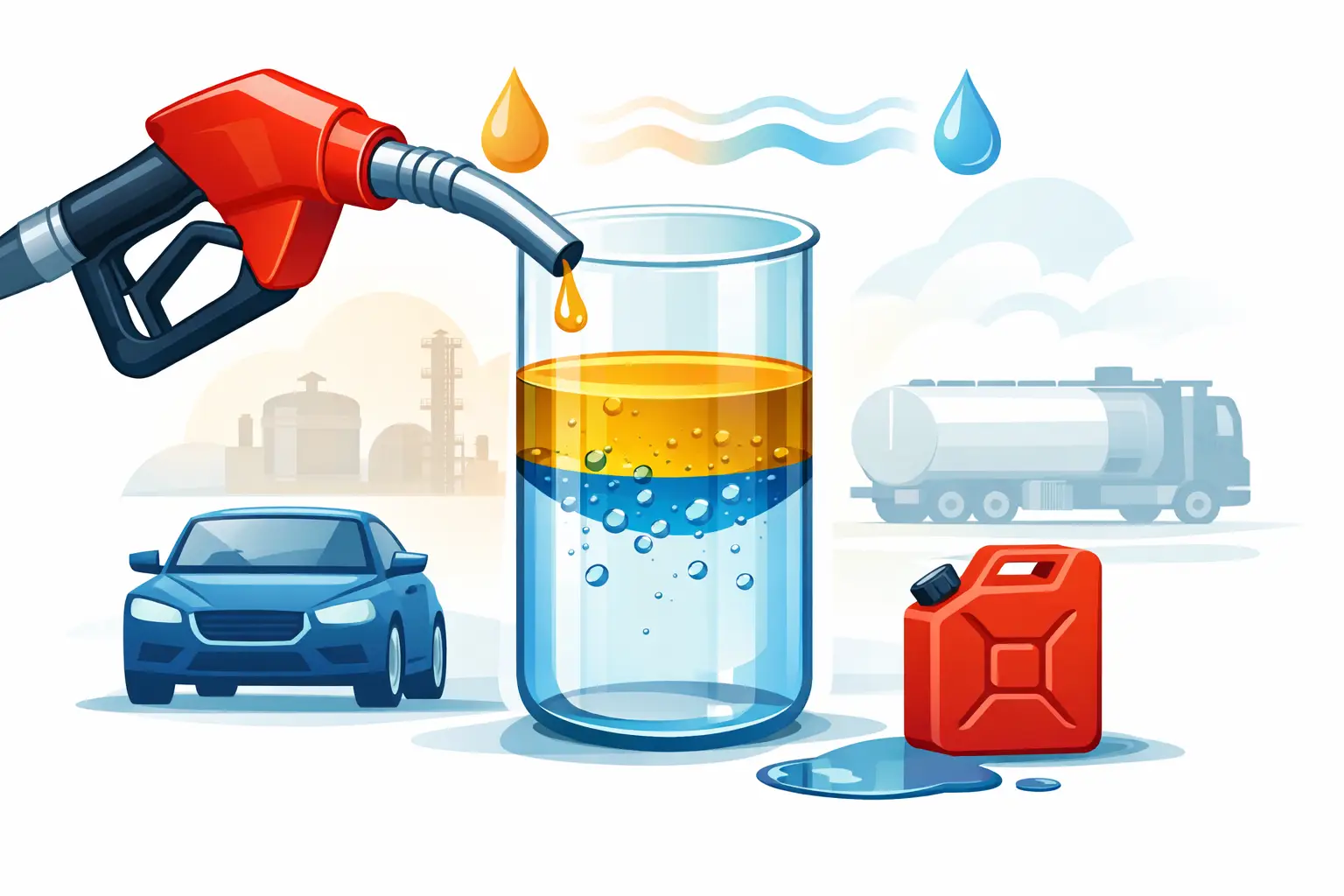
If you drain fuel from the tank, water separator, or a filter into a clean, transparent catch cup, you can often already see a lot. Petrol and water don't mix well. If you let the sample sit for a moment, the water usually forms a separate layer at the bottom.
Fresh, clean petrol looks clear. If there's water in it, you can see a distinct colourless layer at the bottom or a cloudy transition between the liquids. Sometimes the fuel looks milky or dull. That doesn't automatically mean there's a lot of water in it, but it does mean the fuel is suspect.
With older ethanol-blended petrol, it gets trickier. Ethanol can absorb a limited amount of moisture. As a result, the fuel can still look reasonably homogeneous at first, while it already contains too much water. Once that threshold is exceeded, you get phase separation. A water-ethanol mixture then sinks to the bottom, leaving petrol of reduced quality on top. For the engine, that's a bad combination.
Also smell the fuel. Spoiled or old petrol has a different, heavier smell than fresh fuel. That's not the same as water in gasoline, but it often occurs together, especially on boats that have sat idle for a long time.
Where does water in gasoline on boats usually come from?
The first suspect is condensation. A tank that spends the winter half-full has a lot of air volume above the fuel. Temperature swings then cause condensation to form. Over time, that can be enough to cause problems, especially if the boat sails little and the tank contents sit for a long time.
You also regularly see problems via the fuel cap or vent. A worn seal, an incorrectly fitted cap, or water that stays sitting around the filler opening after cleaning, rain, or splashing can get into the tank. On some boats, the filler opening is simply positioned unfortunately, letting water in faster than owners think.
Lower-quality fuel or a contaminated jerry can can also be the cause. That happens more often than people think. A jerry can that's left outside, doesn't seal well, or is internally contaminated brings the problem straight into the tank. Especially with seasonal use, it pays to also critically look at the tools you use for refuelling.
Which parts often show problems first?
The water separator or fuel filter often catches the first signal. That's favourable, since it means not everything reaches the engine directly. But if the amount of water is too large, or the filter is already old, the system still becomes saturated. Then you still get faults further down the line.
On carburetted engines, water can cause poor idling, stalling, and contamination in the float bowl. On fuel-injected engines, injectors, pressure regulators, and fuel pumps can react sensitively. Water doesn't lubricate and also causes corrosion. So the problem isn't just that the engine runs poorly, but also that parts get damaged over time.
For an engine that has run on water-contaminated fuel for a while, you therefore need to look more broadly than just the tank. Filters, lines, the pump, and depending on the system, also the injection or carburettor may need follow-up attention.
How to check it without unnecessarily replacing parts
Start with the simple check: drain the water separator, if the system allows it. Catch the contents in a clear jar and let it sit for a moment. If you see a separate layer at the bottom, you know enough. If the filter element is old or questionable, replace it regardless. That's maintenance, not a guess.
Then check whether the fuel cap seals properly and whether the vent is in good condition. Also look at recent circumstances. Has the boat been sitting idle for a long time, has it recently been refuelled from a loose jerry can, or has there been a lot of rainwater around the filler opening? That helps with the diagnosis.
If you have access to a sample from the lowest point of the tank, that's even better. Water sits at the bottom, after all. Not every boat makes that easy, but if you can sample there, you get the most reliable picture.
Don't randomly replace coils, spark plugs, or sensors right away if the complaints fit fuel contamination just as well. In practice, we regularly see that all sorts of things have already been replaced while the real problem was simply water in the gasoline.
When is it still a small problem, and when isn't it anymore?
That depends on the amount of water, the type of engine, and how long you've kept sailing with it. A small amount of moisture that gets caught in time in the water separator is usually still manageable. In that case you often get away with changing the filter, assessing the tank contents, and adding fresh fuel or draining the old fuel.
If the engine becomes genuinely unreliable, stalls under load, or shows clear phase separation, you need to take it more seriously. In that case, a new filter alone is usually not enough. The tank often needs to be emptied and the system needs to be cleaned before you can sail reliably again.
With corrosion in components or damage to the pump and injection system, the repair quickly gets bigger. That's exactly why early recognition matters so much. Continuing to sail because the engine "sometimes picks up again" is rarely a good strategy on the water.
How do you prevent water in gasoline?
Ruling it out completely isn't always possible, but you can significantly reduce the risk. Make sure the fuel cap and seal are in good condition. Use clean jerry cans, don't let fuel age unnecessarily, and replace the water separator on time. For seasonal boats, it also helps to deliberately look at tank level and fuel condition before winter storage instead of only doing so in spring.
For boats with MerCruiser engines, a good fuel filter with water separation isn't a luxury, but simply sensible maintenance. That's especially true if the boat is stored outside or used irregularly. If you're unsure about the correct filter set or replacement parts, technically appropriate advice matters more than just ordering something that seems to fit "roughly".
How do you recognize water in gasoline when the complaints are ambiguous?
Sometimes the picture isn't black and white. Poor starting can also come from ignition. Hesitation can also be a contaminated filter, a poor pump, or old petrol. That's why you always need to look at the whole picture: when did the complaints start, under what circumstances, and what does a fuel sample show?
That exact combination makes the difference between a targeted fix and unnecessary searching. If you work on your own boat, it pays to test systematically. And if you can't figure it out, it saves a lot of time to have someone with practical experience in MerCruiser fuel systems take a look. Mercruiser-onderdelen.com helps with that every day, not just with parts, but also by thinking along technically.
Water in gasoline is rarely spectacularly visible, but it's usually well recognisable once you know what to look for. So don't wait until the engine stops running altogether, address the first signs right away, that prevents more damage than any quick fix ever could.


