

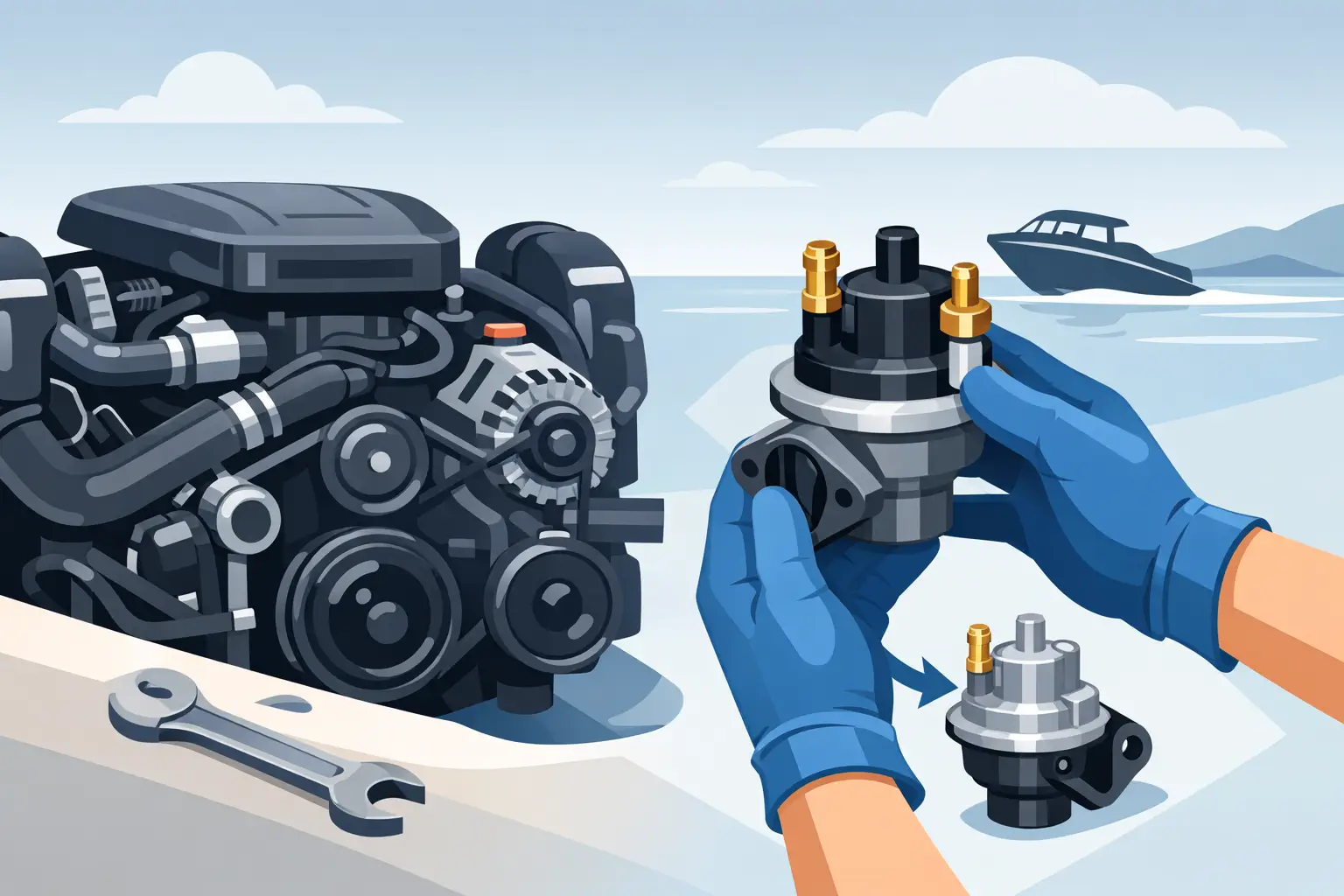
MerCruiser Fuel Pump Replacement
A MerCruiser that struggles to pick up, hesitates under throttle, or simply cuts out on the water often points to the fuel supply faster than many owners think. Replacing a MerCruiser fuel pump comes up regularly, especially on engines that have been sitting for a while, that suffer from contaminated fuel, or that have run on the same pump for years.
The tricky part is that a fuel pump rarely fails completely in one go. Often it starts with subtle complaints. The engine still starts, but with more difficulty. Under higher load, the rpm drops off. Or you notice that the boat idles fine but lacks power under load. That's exactly when it's important to look not just at the pump itself, but at the entire fuel system.
When is replacing a MerCruiser fuel pump necessary?
You don't replace a fuel pump just because the engine won't start. In practice there are several signs that can point to wear or a fault. Think of a humming or irregular pump noise, fuel pressure that drops out, difficulty starting after standing still, or an engine that cuts out as soon as you demand power.
Carburetted engines tend to show different symptoms than MPI or EFI versions. A mechanical pump on an older V6 or V8 usually causes complaints like irregular fuel delivery, fuel leakage, or a worn diaphragm. With electric pumps on fuel-injected engines, it's more often about pressure loss, contamination, or a pump that cuts out thermally once the engine warms up.
That's where the first nuance comes in. Not every complaint means the pump itself is faulty. A clogged fuel filter, air leaking into the line, a contaminated tank, or a faulty relay can produce exactly the same symptoms. Ordering too quickly sometimes means replacing the wrong part.
Proper diagnosis first prevents unnecessary costs
Before starting to replace a MerCruiser fuel pump, a simple but targeted diagnosis is wise. First check whether fuel pressure is actually present and whether it falls within your engine's specifications. This is especially important on fuel-injected engines, since even a small deviation is noticeable in starting, idling, and acceleration.
Also look at the basics. Is there clean fuel in the tank? Has the water separator been replaced recently? Have the hoses become hard or porous? Is there voltage reaching the pump when you switch on the ignition? Especially on boats that are used infrequently or have spent a long winter in storage, the problem often lies in contamination or aging fuel components.
On some MerCruiser models, the combination of low- and high-pressure pumps plays a role. In that case the complete set doesn't always need replacing, but you do need to know exactly which part of the system is failing. In practice this is often where things go wrong, especially when the boat has previously been modified or fitted with an aftermarket solution.
Which fuel pump fits your MerCruiser?
That depends on more than just the number of cylinders. Model year, serial number, fuel system, and engine type are all decisive. A 4.3 V6 with a carburettor requires a different solution than a 5.0 MPI or a 7.4 litre V8. Even within the same displacement, there can be variants with different connections, operating pressure, or mounting points.
That's why searching by model name alone isn't always enough. In the workshop we regularly see a pump that physically fits but isn't technically correct. The result is an engine that runs too lean or too rich, starts poorly, or runs unevenly under load. Especially with EFI and MPI, you don't want to take a gamble.
Original parts offer the most certainty in terms of fit and specification. A good aftermarket alternative can work perfectly well, but only if the quality and correct version are confirmed. The price difference can be worthwhile, but on the water, reliability weighs more heavily than a few euros' difference.
Replace it yourself or have it done?
For a handy boat owner, replacing a fuel pump is sometimes straightforward to do yourself, but that depends heavily on the engine type and the pump's location. A mechanical pump on an older engine is generally more straightforward than an electric pump in a more modern injection system. As soon as pressure, electrical controls, and multiple components are involved, the risk of mistakes increases quickly.
Working safely is not a minor detail here. You're working with fuel vapours in an enclosed engine compartment. That means disconnecting the battery, ventilating properly, cleaning up spills immediately, and always checking for leaks after installation before starting the engine. Being careless about this creates a problem far bigger than a poorly running engine.
If you're unsure about the diagnosis or the correct pump, getting help is usually cheaper than ordering twice or breaking down during boating season. That's especially true when filters, lines, or an anti-siphon valve are also involved in the fault.
How the replacement works in practice
A proper replacement starts with identifying the exact engine type and the correct pump. Next comes depressurising the system, disconnecting electrical connectors and fuel lines, and removing the old pump. During this work, immediately check the condition of hoses, couplings, and any gaskets.
Then you fit the new pump with the correct seals and in the correct way. Mounting it too tightly or at an angle will later cause leaks or stress in the housing. After installation, bleed the system where needed, check the voltage, and let the engine idle before taking it out for a test run.
What's often forgotten is finding the cause of the original fault. If a pump failed due to contaminated fuel or water in the system, a new pump can sometimes fail again without further measures. In that case, replacing it fixes the symptom, but not the root of the problem.
Common mistakes when replacing a MerCruiser fuel pump
The most common mistake is ordering a pump based on engine displacement alone. A second mistake is skipping the filter replacement. Fitting a new pump behind a contaminated filter is asking for trouble. We also see old hose clamps or dried-out lines being left in place, which then start leaking right after disassembly.
Another mistake is ignoring electrical causes. A pump that doesn't run isn't always broken. Corrosion in the connector, a faulty relay, or voltage loss can produce the same effect. Anyone who only swaps the pump in that case will end up with exactly the same fault later.
On carburetted engines, people sometimes forget to properly clean the gasket surfaces or to correctly check the operation of the pump linkage. On fuel-injected engines, the risk more often lies in incorrect pressure values or a pump whose flow rate just isn't quite suitable. That may seem minor, but you'll notice it immediately on the water.
Choice of parts: original or aftermarket?
For many boat owners, that's a practical trade-off. Original or Quicksilver parts generally offer the most certainty in terms of dimensions, connections, and lifespan. That's especially convenient when you want a quick repair without hassle. Aftermarket parts can be attractive in price, especially on older engines, but then the source needs to be reliable and the technical specification needs to be correct.
For a fuel pump, the cheapest option is rarely the best choice if reliability matters to you. A boat that runs fine at the dock but fails underway ultimately costs more time, money, and frustration. That's why it pays to base your parts choice on usage, engine configuration, and the condition of the rest of the system.
For owners who are unsure about compatibility, it's wise to work from the serial number and engine details. That prevents mistakes and saves on returns. At mercruiser-onderdelen.com, that check is carried out daily, precisely because in practice there's a lot of variation between engines that look similar at first glance.
Also check the rest of the fuel system
While you're at it, look beyond just the pump. A worn filter, a contaminated tank pickup, a porous hose, or an aged seal can immediately undermine the performance of the new pump. Especially on boats used seasonally, it's often wise to preventively check the entire fuel path.
That also applies after winter storage. Fuel ages, condensation causes moisture, and deposits build up in filters and lines. The pump then seems to be the culprit, while the system as a whole needs attention. A good repair therefore isn't just about replacing, but also checking, cleaning, and renewing where needed.
Anyone who wants to stay ahead of faults usually benefits more from a targeted inspection than from blindly swapping parts. That saves not just money, but also valuable days on the water. And that's really what it's all about: making sure your MerCruiser starts, runs smoothly, and simply does what it's supposed to do the moment you cast off.


