

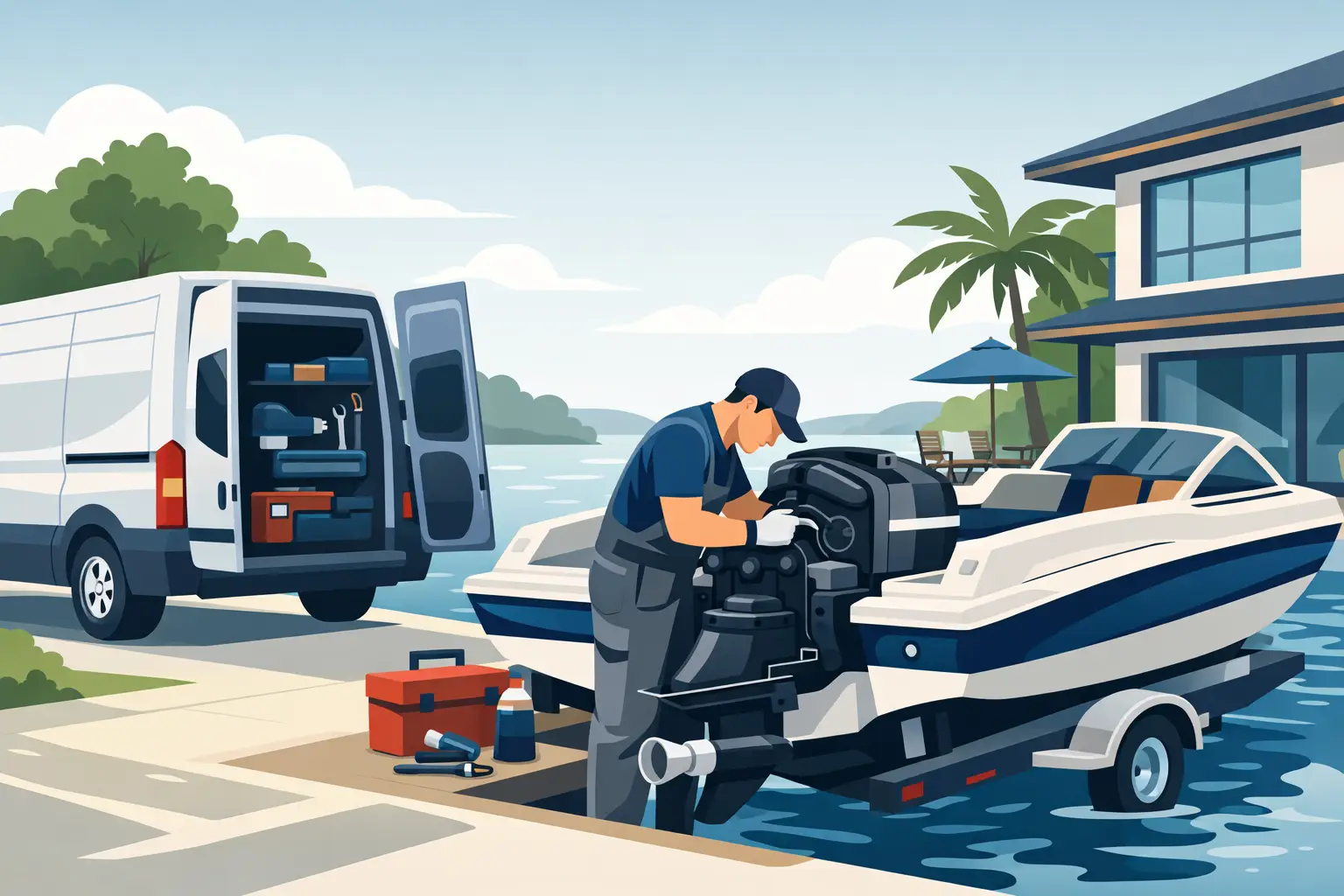
MerCruiser Maintenance at Home: Arranged the Smart Way
A boat that won't start on the day you want to go out is always a hassle. Especially with a MerCruiser installation, where engine, cooling, fuel system, and sterndrive all need to stay properly matched to each other. That's exactly why more and more boat owners are choosing MerCruiser maintenance at home: practical, fast, and without unnecessary hauling of the boat or parts.
For many owners, on-site service isn't just convenient, it's simply the smarter choice. The boat is already in the marina, on the trailer, or in winter storage. In that case, you want someone who can inspect, maintain, and replace parts directly on site where needed. That saves time, prevents incorrect diagnoses, and makes it easier to tailor maintenance to the engine's actual condition.
Why choose MerCruiser maintenance at home?
Maintaining a MerCruiser is rarely about just one single action. A small service seems simple, but in practice everything is connected. Think of the impeller, thermostat housing, bellows, anodes, oil, filters, ignition, trim, and the condition of the sterndrive. Anyone who only replaces one part without looking at the bigger picture risks another weak point causing problems shortly after.
MerCruiser maintenance at home is especially valuable because the actual situation of the boat is directly visible. If the boat sits in the water for long periods, corrosion and fouling play a bigger role. If it's on a trailer, bearings, seals, and winter preservation become extra important instead. Usage pattern also makes a difference. A sports boat that does short, fast runs needs something different than a boat that's used gently but sits idle for months.
On-site service is also handy if you already know something's wrong but not exactly which parts are needed. Many faults look alike. A rough-running engine can be caused by contaminated fuel, ignition problems, a sensor, a vacuum leak, a cooling issue, or overdue basic maintenance. In that case, a technical inspection on site is usually more efficient than guessing remotely.
What does on-site maintenance cover?
That depends on the engine variant, the sterndrive, and the boat's condition. For a 4-cylinder, V6, or V8, the basic principles are similar, but the parts and settings naturally differ. Alpha One and Bravo drives come with different points of attention than engine maintenance alone.
In practice, it's often about periodic maintenance such as oil changes, replacing the oil filter and fuel filter, checking or replacing the impeller, inspecting or renewing spark plugs, lubricating pivot points, checking the drive, and inspecting hoses, clamps, and electrical connections. Bellows, anodes, trim parts, and cooling system components are often included as well.
Sometimes an appointment starts out as regular maintenance and inspection reveals more is going on. For example, water in the sterndrive oil, a leaking exhaust manifold, a poorly functioning trim pump, or wear on the gimbal bearing. That's exactly where specialist MerCruiser knowledge makes a difference. Not every issue immediately calls for a complete overhaul, but continuing to sail too long with the wrong noise or a small leak often ends up more expensive.
Engine and sterndrive maintenance belong together
A common mistake is viewing the engine and the drive as separate. On a MerCruiser, they form one system. If the engine runs perfectly but the drive loses oil or has too much play, the boat remains vulnerable. The reverse also applies: a freshly serviced Alpha One or Bravo is worth little if the fuel supply or ignition on the engine isn't in order.
That's why a broad check is often more useful than just fixing the complaint. Especially on boats whose maintenance history is unclear, it pays to first do a proper baseline check. Then you know which parts can still go on and which are better addressed right away.
When is maintenance at home the best choice?
On-site maintenance is especially interesting in four situations. First, when transport is difficult or expensive. Taking a boat out of the water, moving it, and bringing it back quickly costs more time and money than the service itself. Second, when you want to be back on the water quickly. During the season, every week of downtime counts.
Maintenance at home also makes sense for winter preparation and getting ready for the season in spring. That's exactly when you want antifreeze, preservation, battery condition, fuel system, and cooling checked in the right place. The fourth situation is when you're unsure about a fault and want a targeted diagnosis first before ordering parts.
Not everything can always be done on site. For bigger overhauls, heavy welding work, or complex damage, a workshop approach may be better. But for a large part of regular maintenance and common repairs, service at the boat is an efficient solution.
What gets extra attention during an inspection?
With MerCruiser systems, there are a few parts that relatively often cause surprises. Cooling is a clear example. An impeller can still just about function while already being deformed or dried out. That raises the risk of overheating right at the moment you sail longer or demand more power.
Exhaust manifolds and risers also deserve attention, especially in salt or brackish water and on boats that aren't used intensively but are used over multiple seasons. From the outside it can still look acceptable while internal corrosion has already started. That's exactly the kind of point where preventive replacement is sometimes cheaper than waiting for consequential damage.
On the sterndrive, checks include oil condition, seals, shifting behaviour, bellows, and anodes. Milky oil often points to water ingress. Worn or leaking bellows can lead to bigger problems around the bearing and universal joint. Those aren't details to postpone.
Electrical faults are also regularly underestimated. A poor earth connection, oxidised connectors, an aging starter solenoid, or weak charging voltage all cause complaints that occur irregularly. That's exactly why on-site maintenance helps: the boat is examined in the situation where the fault actually occurs.
Choice of parts: original or aftermarket?
For many customers, that's a fair question. Not every part necessarily has to be original, but not every aftermarket part is automatically a good saving. It depends on the application, the load, and the type of part.
For critical components in cooling, sealing, ignition, or the drive, fit and material quality matter. So when it comes to maintenance, it's smart to look not just at price but also at lifespan and reliability. Especially in peak season, you'd rather repair it properly once than cheaply twice.
On the other hand, there are also replacement parts that work perfectly well and offer a neat solution when the original is less attractive price-wise. The advantage of a specialist is that you get honest advice on that, based on the engine type and the boat's actual use. At MerCruiser-Onderdelen.com, that combination of parts knowledge and practical experience is exactly why customers don't just order, but also ask for targeted advice.
DIY or outsource?
Many MerCruiser owners enjoy tinkering themselves, and that's fine as long as the basics are right. Changing oil and filters, checking spark plugs, or carrying out a simple inspection can be manageable for a handy owner. But as soon as diagnosis, the cooling system, sterndrive sealing, or the adjustment of multiple systems at once come into play, specialist experience becomes more valuable.
It's not just about fitting parts, but above all about recognising the cause. Does the fault really lie in the part you have in mind, or is that just a consequence of something else? That question often determines whether you're back on the water quickly or lose weeks to isolated repair attempts.
A practical middle ground usually works best. Do what's reasonable yourself, and bring in a specialist for diagnosis, periodic major maintenance, or doubtful cases. That keeps a grip on costs without taking unnecessary risks.
MerCruiser maintenance at home prevents costly downtime
Most big repairs start with something small that was left too long. An impeller that just had to last one season too many. Bellows with early cracks. An exhaust part that "could still hold on". Especially on boats used seasonally, overdue maintenance creeps in easily.
By scheduling MerCruiser maintenance at home in good time, you keep track of the engine and drive's condition. You prevent surprises at the dock and increase the chance that parts are chosen correctly right away. That's not just more pleasant while boating, but usually better for your maintenance budget in the longer term.
Anyone who uses their boat seriously knows that reliability isn't a luxury but simply part of enjoying time on the water. So don't wait until a small point of attention becomes a summer problem. A good on-site check gives peace of mind, clarity, and often exactly the practical solution you need to start out with confidence again.


