

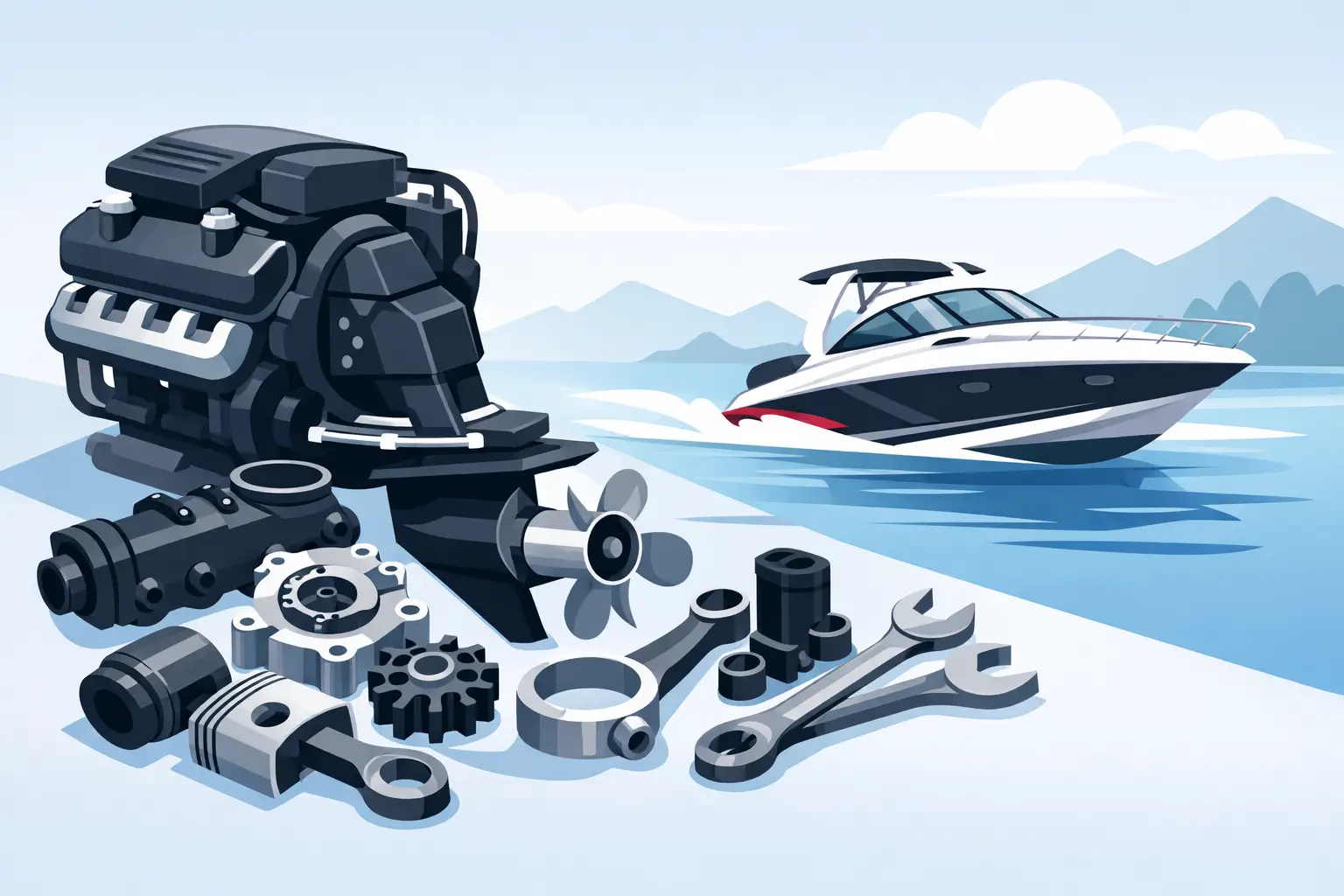
OEM or Aftermarket MerCruiser Parts
An impeller that just doesn't quite fit, a trim relay that fails early, or a gasket that leaks again after a short time, those are exactly the situations where the choice between OEM or aftermarket MerCruiser parts suddenly stops being a matter of price and becomes a practical decision with consequences for your time on the water. Especially during the season, you don't want to guess. You simply want the right part, fitting your engine or drive, with as little downtime as possible.
When do you choose OEM or aftermarket MerCruiser parts?
The short version is simple: it depends on the part, the application, and how critical fit and reliability are. OEM stands for original specification. With MerCruiser, that usually means original MerCruiser or Quicksilver parts, made to the factory specifications for that system. Aftermarket is a replacement part from a different manufacturer, intended as an alternative to the original.
That doesn't automatically mean OEM is always better and aftermarket is always a compromise. In practice, it's more nuanced. Some aftermarket parts are perfectly fine for regular maintenance. Others are less suitable for critical engine parts, cooling, ignition, or components where dimensions and material choice really matter down to fine tolerances.
For many boat owners, the trade-off comes down to three things: reliability, price, and availability. If you want to be back on the water quickly in the middle of the season, immediate availability can weigh heavily. But for parts deep inside the engine or sterndrive, cheap can end up costly if you have to redo the work later.
The real difference is often not on the box, but in the application
On paper, many parts look interchangeable. A water pump kit, starter motor, thermostat, bellows, or exhaust hose is often offered as fitting multiple MerCruiser configurations. Yet the difference often lies in the details. Think of tolerances, rubber quality, corrosion coating, electrical connections, or the exact shape of a gasket surface.
With OEM, you generally know better what you're getting. That gives peace of mind for repairs where disassembly takes a lot of time. You'd rather not fit an Alpha One water pump or a set of exhaust manifold gaskets twice because an alternative part turns out slightly different in fit or lifespan.
Aftermarket, on the other hand, can be a very sensible choice for parts where the engineering is less complex or where good replacement manufacturers have already proven themselves for a long time. Filters, some maintenance parts, sensors, or standard electrical components can work perfectly well as aftermarket solutions, provided the part comes from a reliable source and is correctly selected based on serial number or engine type.
OEM is often the safe choice for critical parts
For internal engine parts, sterndrive components, ignition parts with specific tolerances, cooling, and seals, OEM is often the logical route. Not because every aftermarket part is bad, but because the margin for error in these areas is small. A wrong impeller, inferior bellows, or a less accurate sensor can lead to overheating, water ingress, or faults that aren't immediately visible.
With newer or more heavily loaded installations too, such as V6 and V8 engines used sportily, it's wise to steer less towards the lowest price and more towards proven quality. A part that has to keep performing stably under load needs to not just fit, but also perform reliably over time.
Aftermarket is worth considering when price and availability weigh more heavily
Not every repair calls for the most expensive route. For older engines, commonly performed service jobs, or cosmetically less critical replacements, aftermarket can simply be economically smart. Especially if an original part is hard to source or disproportionately expensive relative to the installation's residual value.
An important condition applies here, though: you need to be certain the alternative is technically correct. MerCruiser has many variants across 4-cylinder, 6-cylinder, and 8-cylinder versions, plus differences between Alpha One, Bravo, and various drive versions. A part that fits "roughly" is in practice often the wrong part.
Price difference doesn't tell the whole story
A common mistake is looking only at the purchase price. But the real cost also lies in installation hours, downtime, extra gaskets, oil, coolant, and possible consequential damage. A cheap circulation pump that leaks early costs more than just that pump. You have to disassemble, refill, and test everything again.
So the question isn't just: what does the part cost? The better question is: what does it cost if this part doesn't perform well? For hard-to-reach spots in the engine bay or sterndrive overhauls, that difference is significant. For a simple service part with a quick replacement, the risk is often smaller.
For many customers, this approach works best: save where it's reasonable, and choose original where failure directly leads to greater damage or extra labour. That's not a sales pitch, just workshop logic.
Where does it most often go wrong in practice?
Most problems don't arise because someone deliberately makes the wrong choice, but because a part is ordered based on model name instead of serial number. "MerCruiser 5.0" sounds clear, but within that engine family there are different model years, cooling configurations, ignition systems, and mounting differences.
That plays out even more strongly with sterndrives. Alpha One Gen I and Gen II are still regularly confused with each other. With Bravo systems too, small differences in sealing, bearing, or water pump construction can have big consequences. That's when it matters extra whether you choose OEM or aftermarket MerCruiser parts, since alternative brands sometimes describe their product specification more generically.
A second pitfall is mixing without a plan. For example, using an aftermarket gasket but combining it with an original housing whose surface or torque requirements are more sensitive. Or fitting an unknown trim motor onto a system that already has wear in the wiring or relay. The problem then seems new, but part of the cause lies in the combination.
How we look at it in practice
We usually don't judge that choice by brand name, but by part category. For maintenance parts such as some filters, belts, and standard service kits, a good aftermarket alternative can work out perfectly well. For cooling parts, sterndrive components, bellows, ignition, and critical seals, we often advise more caution.
That has everything to do with experience from maintenance and repair. What looks the same in a webshop photo doesn't always behave the same in the workshop. Material strength, fit, and finish often only really show up during installation or after a season of use. That's exactly why technical selection carries more value than just a low price or a broad product title.
For customers who work on their own boats, that's just as important. If you're at home tackling a service job or repair, you want to receive parts you're reasonably confident will fit right away. Every wrong order costs time, frustration, and often extra shipping or disassembly costs.
OEM or aftermarket MerCruiser parts per situation
For a winter service, major maintenance, or preventive replacement, there's usually more room to calmly choose the best option. Then you can more deliberately weigh where aftermarket is reasonable and where original remains preferable. During acute failure in peak season, availability often weighs more heavily. Then you want a solution that's quickly available and remains technically sound.
For older boats, the trade-off is different than for newer installations. On an older MerCruiser engine, a good aftermarket part can be a perfectly good way to keep the boat economically operational. But if you demand a lot of power, make long trips, or depend on maximum reliability, the choice often shifts back towards OEM.
Usage profile matters too. A boat that occasionally cruises calmly on inland water places different demands than a sports boat that's heavily loaded, revs high, or sits in salt water. Corrosion resistance, cooling, and material choice then become more important. That makes generic advice less useful than parts advice based on engine, drive, and use.
The best choice starts with the correct part number
Anyone who really wants to choose well between OEM and aftermarket doesn't start with a price comparison, but with identification. Engine type, serial number, drive version, and sometimes even model year or application are needed to prevent mistakes. Only after that can you honestly compare on quality, delivery time, and budget.
That's also why direct contact often works faster than endless searching on your own. Especially when in doubt about an impeller kit, exhaust manifold, trim pump, starter motor, carburettor or injection part, ignition component, or complete gasket set. A photo, serial number, or short description of the complaint often prevents you from ordering the wrong thing.
At mercruiser-onderdelen.com, we see every day that customers are mainly looking for certainty. Not necessarily the most expensive part, but the right part. Sometimes that's original, sometimes a solid aftermarket alternative. Getting that choice right beforehand prevents a lot of hassle afterwards and keeps the boat available whenever you want to use it.
Anyone torn between OEM and aftermarket MerCruiser parts doesn't need to see it in black and white. Look at the function of the part, the load, the installation time, and the consequences if it fails. Then you're not making a cheap or expensive choice, but a wise one, and that's ultimately what makes for the most pleasant boating.


