

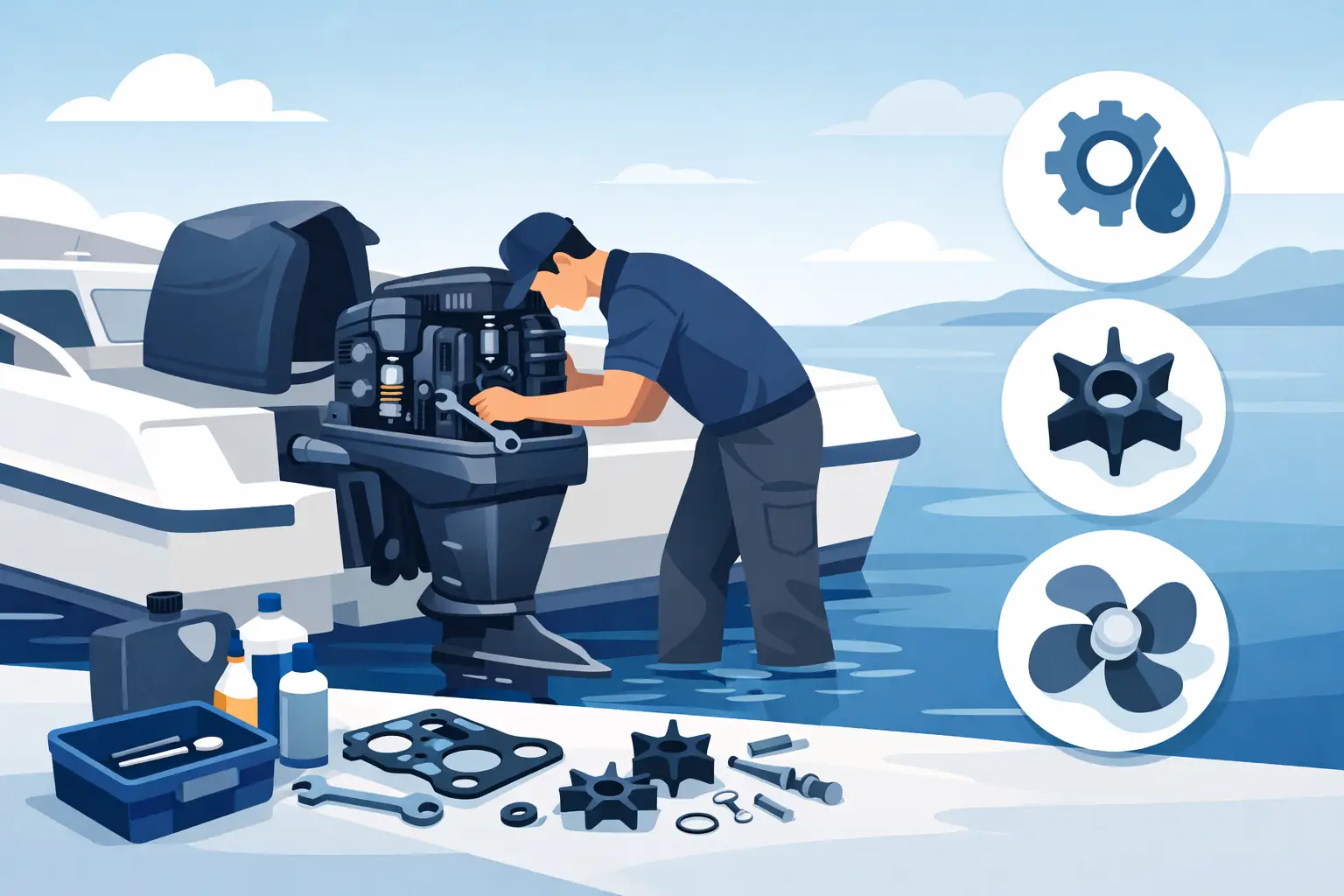
Replacing a 300-Hour Transom Service Kit
Anyone who maintains a MerCruiser with a sterndrive knows that delaying work around the transom plate almost always ends up more expensive than replacing it on time. A 300-hour transom service kit is designed to prevent exactly that: leakage, play, stiff steering, and wear around parts that carry heavy loads and are hard to reach once problems grow bigger.
On many boats, attention mainly goes to the impeller, oil, and bellows, while the transom parts only get attention once water starts coming in or the drive noticeably behaves differently. That's a shame, because right around 300 hours is often when you see rubber parts harden, seals become less reliable, and pivot points lose the tight fit you want. For owners who want to keep their boat operationally reliable, this maintenance isn't a luxury, but planned work.
What is a 300-hour transom service kit?
A 300-hour transom service kit is a maintenance set for the transom assembly of a MerCruiser sterndrive. The exact contents differ per version, model year, and drive type, but it usually covers wear parts and seals located around the transom plate, steering pin, pivot points, and pass-throughs.
So it's not a universal service package that fits every Alpha or Bravo. That's an important point right away. Within MerCruiser, there are many differences between models, serial numbers, and revisions. A kit that looks almost identical on paper can in practice have a slightly different fit, seal, or size. That's why correct identification beforehand matters more than ordering quickly based on engine type alone.
Why act specifically around 300 hours?
The term "300 hours" isn't a magic number, but it is a practical maintenance point. In practice, many boats reach a stage at that point where normal ageing becomes visible. Especially on boats that spend a lot of time in the water, make many trim movements, or run under load, transom components take quite a beating.
Rubber parts age not just from running hours, but also from inactivity, temperature swings, salt, UV, and moisture. A boat with relatively few hours can therefore still be due for a transom service, while another boat with more hours is still surprisingly good. That's why we always look at both hours and condition. Maintenance based purely on the hour counter is often too simplistic for sterndrive systems.
Parts often included in a 300-hour transom service kit
What you exactly need depends on your set-up. Still, there are a few parts that often recur when a 300-hour transom service kit is put together or replaced. Think of seals, O-rings, bellows-related parts, pivot or steering components, and sometimes mounting hardware that's better not reused after disassembly.
In some jobs, it stays limited to preventive replacement of sealing parts. In other cases, disassembly reveals that extra work is needed too, for example when a pin has seized, a bearing no longer runs smoothly, or corrosion has left marks around the mating surfaces. That's exactly the difference between theory and workshop practice. A kit doesn't automatically fix deferred maintenance.
Not every kit is complete for every repair
A common mistake is thinking a service kit automatically contains everything needed to rebuild the entire transom system like new. That's rarely the case. A kit is intended as a maintenance set, not a full overhaul set. If there's already leakage, excessive play, or visible damage, additional parts are often needed.
That's especially true for older installations where the original assembly was done years ago and where previous repairs were carried out with various parts. In that case, you shouldn't work solely based on the kit's contents, but genuinely assess what's technically sound.
Signs that replacement shouldn't wait any longer
In practice, there are a few complaints that often point to wear around the transom assembly. Water in the bilge with no clear cause is one. Stiff or imprecise steering behaviour is another. We also regularly see issues like a drive that no longer moves smoothly, unexplained leakage around pass-throughs, or a boat with missing maintenance history where preventive replacement is simply the wiser call.
If the drive already has to come loose for other work anyway, this is a logical moment to take a critical look at the transom parts. The extra labour mostly comes from disassembly and accessibility. If everything's already open, saving on a few wear parts is usually a costly economy.
300-hour transom service kit for Alpha and Bravo
For a 300-hour transom service kit for Alpha One or Bravo sterndrives, model recognition is essential. Many parts look very similar to each other, but small differences make the difference in practice between fitting and being unusable. Think of variations in model years, steering construction, seal version, or how a part is mounted in the transom assembly.
For Alpha systems, the emphasis is often on typical wear points that otherwise cause play or leakage. On Bravo versions, the load can be higher, and you more often see that inspection of adjacent parts directly comes into play. Which set is suitable therefore depends not just on the drive, but also on the serial number and the condition of the rest of the system.
Original or aftermarket?
That's not a black-and-white choice. Original MerCruiser or Quicksilver parts often offer the most certainty in terms of fit and material quality, especially for critical seals and parts that are hard to reach after installation. Aftermarket can work perfectly well if it comes from a reliable line and is applied correctly.
The right choice depends on the part, how the boat is used, and the available budget. For a boat used intensively, or where disassembly costs a lot of work, fitting something cheap in the wrong place is rarely wise. On the other hand, not every part needs to be original by definition to function well.
DIY or have it done?
An experienced DIYer can carry out part of this work themselves, but don't underestimate the transom assembly. Access is often limited, disassembly requires the correct order, and alignment remains important. On top of that, you only see once it's opened up whether the wear really falls within expectations.
Anyone tackling it themselves needs to be certain beforehand that the correct kit has been chosen and that any additional parts are quickly available. Nothing is more annoying than a boat left half-disassembled in the middle of the season because one seal, pin, or gasket turns out to be different after all. That's exactly why a technical check beforehand is so valuable.
For customers unsure between doing it themselves and outsourcing, a practical approach usually works best. First correctly identify what's needed, then determine whether the job is feasible in terms of time, tools, and experience. Sometimes just supplying parts is enough. Sometimes it's smarter to include inspection or installation as well.
What to pay attention to when ordering
Ordering based on description alone is risky for a 300-hour transom service kit. The right starting point is always a combination of drive type, engine details, and above all the serial number. If the boat is older, or if it's unclear what's been replaced in the past, photos of the current situation are often just as important.
Also pay attention to the reason for replacement. If it's planned maintenance without complaints, a standard matching set is often enough. If there are already symptoms such as leakage, play, or damage, you need to account for additional parts. In that case, it's wiser to have someone take a look first than to blindly order a kit and hope it solves the problem.
That's exactly where specialist parts knowledge makes a difference. At mercruiser-onderdelen.com, we see every day that customers get stuck on nearly identical versions, unclear revisions, or incomplete old documentation. In that case, being able to move quickly matters more than a generic product description.
Good maintenance prevents downtime during the season
The real value of a transom service isn't just in replacing parts, but in preventing unexpected failure at the moment you want to go boating. A leaking or worn transom assembly rarely causes problems at a convenient time. It usually happens right before a holiday, in the middle of a weekend, or when parts aren't immediately available.
By taking the 300-hour point seriously, you keep control over planning, costs, and the availability of your boat. And just as importantly: you prevent relatively small wear from turning into bigger damage to adjacent parts. Anyone unsure which 300-hour transom service kit fits, or what's needed alongside the kit, does well to first gather the correct technical details and only order afterwards. That often saves more than just time.


