

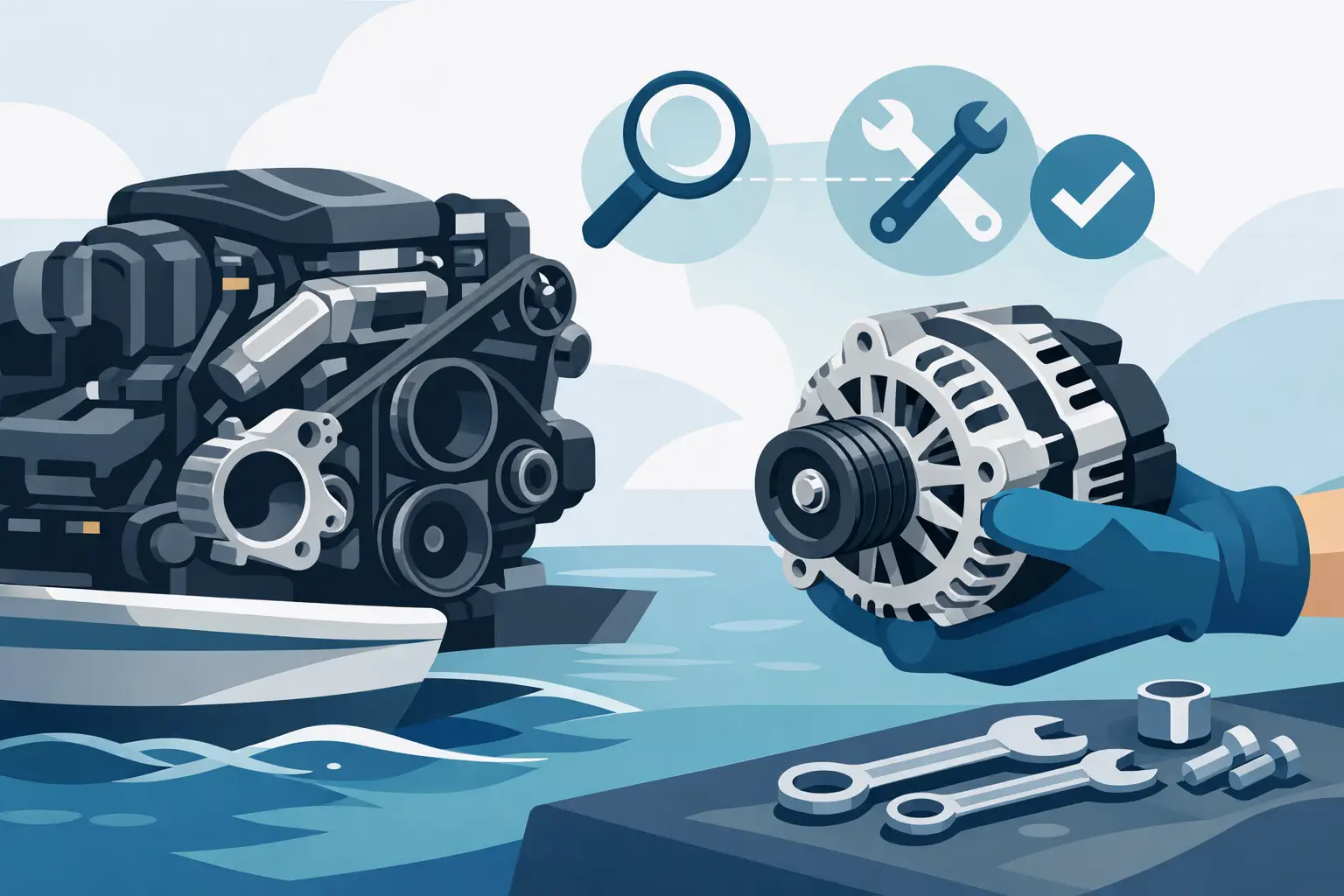
Replacing a MerCruiser Alternator Without Guesswork
A MerCruiser that charges poorly, gives squealing belts, or leaves you with a flat battery after a short day on the water is often not a coincidence but a sign that the alternator is no longer doing its job properly. Replacing a MerCruiser alternator is not a job to postpone, especially not in the middle of the season when you just want to be out on the water and don't have time for searching or an incorrectly ordered part.
On a boat engine, the alternator is more than just a charging component. It keeps the battery topped up, supports ignition and onboard consumers, and prevents small electrical complaints from growing into starting problems or breakdowns underway. Especially with MerCruiser engines, it's important to look not only at the model year, but also at the exact engine type, the version, and the marinisation of the part.
When is replacing a MerCruiser alternator really necessary?
Not every charging complaint automatically means the alternator is faulty. A worn serpentine belt, oxidised battery terminals, a poor earth connection, or a weak battery can produce the same picture. Still, there are a few signs that in practice often point towards replacement.
If the charging voltage stays structurally too low while belt tension and wiring are fine, that's a clear sign. Bearing damage also occurs regularly. You'll often hear a grinding or whining noise that increases with rpm. In other cases, the alternator still charges at first but drops out once warm. That's deceptive, because the engine seems to function normally when cold.
On older MerCruiser installations, we also see internal regulators or diodes failing. That gives you a battery that doesn't fully charge, unstable voltage readings, or faults on electrical consumers. Especially if the boat has been sitting for a while in a damp environment, corrosion may have already caused internal damage.
First rule out what isn't an alternator problem
Before ordering a new alternator, it pays to carry out a few basic checks. That prevents unnecessary costs and downtime. Measure the battery voltage at rest and again with the engine running. Check the condition of the belt and see whether the connections are clean and firmly fastened. Also pay attention to the earth cables between the engine block and the electrical system.
A healthy installation normally shows a higher voltage with the engine running than at rest. If that rise doesn't occur, there's a good chance the alternator or voltage regulator is no longer working properly. But if the belt is slipping or the battery is internally faulty, you'll get similar complaints. So it depends on the full picture, not on a single measurement.
If you're unsure between the battery, the alternator, or the wiring, targeted measuring is faster than replacing parts on guesswork. That's especially true for engines that have been converted at some point or where not all original components are still present.
Which alternator fits your MerCruiser?
This is where things most often go wrong in practice. An alternator can quickly look like it fits at a glance, but with MerCruiser, mounting points, pulley type, amperage, connector fittings, and ignition protection are decisive. An automotive alternator that mechanically roughly fits is by no means always suitable for marine use.
On a boat engine, you have to take the ignition-protected version into account. In the engine bay of a petrol-powered boat, that's not a detail but a safety requirement. There are also differences between 4-cylinder, V6, and V8 MerCruiser engines, and between various serial numbers and model years. Even with Alpha One and Bravo configurations, combinations can occur where the correct alternator can only be confirmed after checking the engine details.
That's why in practice we prefer to work from the serial number, engine type, and preferably also a photo of the current alternator. That prevents returns and downtime. Original MerCruiser and Quicksilver parts are the safe choice if you want to replace exactly according to factory specification. A good aftermarket alternative can also work perfectly well, provided it's technically selected correctly.
Replacing a MerCruiser alternator: what to watch during installation?
Replacing a MerCruiser alternator is manageable for a handy boat owner to do themselves, but only if you work carefully. Always start by de-energising the system by disconnecting the battery. Next, release the belt tension, remove the electrical connections, and remove the alternator from its bracket.
During removal, pay close attention to the position of spacers, washers, and the belt routing. A small alignment error will later cause belt wear, noise, or poor charging speed. So don't just bolt the new alternator in place, but also check that the pulleys line up nicely and the belt is correctly tensioned.
Too tight is just as undesirable as too loose. A belt that's too tight puts unnecessary strain on the bearings, while one that's too loose will slip under load. After installation, check the charging with the engine running and see whether the alternator stays cool and stable. If you smell burning, hear unusual noises, or see an unstable voltage build-up, stop and check the installation again.
Rebuild or replace outright?
That's a logical question, especially on older engines or when the housing still looks neat. Rebuilding can be worthwhile if it's an original unit with limited damage, such as worn bearings or carbon brushes. But rebuilding isn't always the fastest or most cost-effective route.
If the alternator has internal corrosion damage, the regulator is unreliable, or the boat needs to be back on the water quickly, replacing it is often more practical. Especially in peak season, it's not just the price of the part that counts, but also the value of less downtime and fewer hours of labour. A cheap solution that has you back at the dock again within a short time usually ends up being more expensive.
On intensively used sports boats or engines with extra electrical load, it can also be wise to look not just at fit, but also at charging capacity in amps. More isn't automatically better, since the rest of the system has to be matched to it. So the right part isn't necessarily the heaviest one, but the one that suits the engine and installation.
OEM or aftermarket for an alternator swap?
Many customers are unsure between original and replacement. That's understandable. An original MerCruiser or Quicksilver alternator offers maximum certainty in fit and specification. That's especially convenient when you want to fit it quickly without modifications, or when the boat needs to be ready for use without experiments.
Aftermarket can be a good choice if the quality is proven and the specifications match exactly. Especially on older engines where price plays a bigger role, that can be appealing. The trade-off depends on use, budget, and availability. For a boat that mainly sails a few times a month in summer, a good replacement part can be perfectly sufficient. For intensive use or an engine bay where reliability comes first, many owners prefer OEM.
Common mistakes when replacing an alternator
The biggest mistake is ordering based on appearance alone. Two alternators can look very similar and still have different connectors, a different regulator design, or a different pulley. The second mistake is using a non-marine alternator. That can sometimes look like a quick saving, but it's the wrong route both technically and in terms of safety.
We also regularly see an old belt being reused while it's already glazed or stretched. The new alternator then seems to charge poorly, while the cause actually lies in the drive. Earth connections and cable lugs are also sometimes underestimated. A new alternator on a poor electrical circuit still performs below par.
Finally, the cause is sometimes looked at too narrowly. If an alternator keeps failing repeatedly, there may be more going on, such as moisture exposure, a poor battery bank, or overload from extra consumers. Simply replacing without diagnosis then doesn't provide a lasting solution.
Getting back on the water quickly starts with the right part
Anyone who needs to replace a MerCruiser alternator usually doesn't want a technical story for its own sake, just a part that fits and works. Still, it pays to take one extra step in identification. That's exactly what prevents most delays, wrong orders, and double installation work.
At mercruiser-onderdelen.com, we help with that every day, based on engine details and practical experience from maintenance and repair. That's especially useful if you're unsure between multiple versions or if the current alternator is no longer original.
If your engine has charging problems, don't wait until the boat stalls at the wrong moment. A well-chosen alternator, correctly installed and matched to your MerCruiser, usually gives immediate peace of mind on board and confidence for your next day out.


