

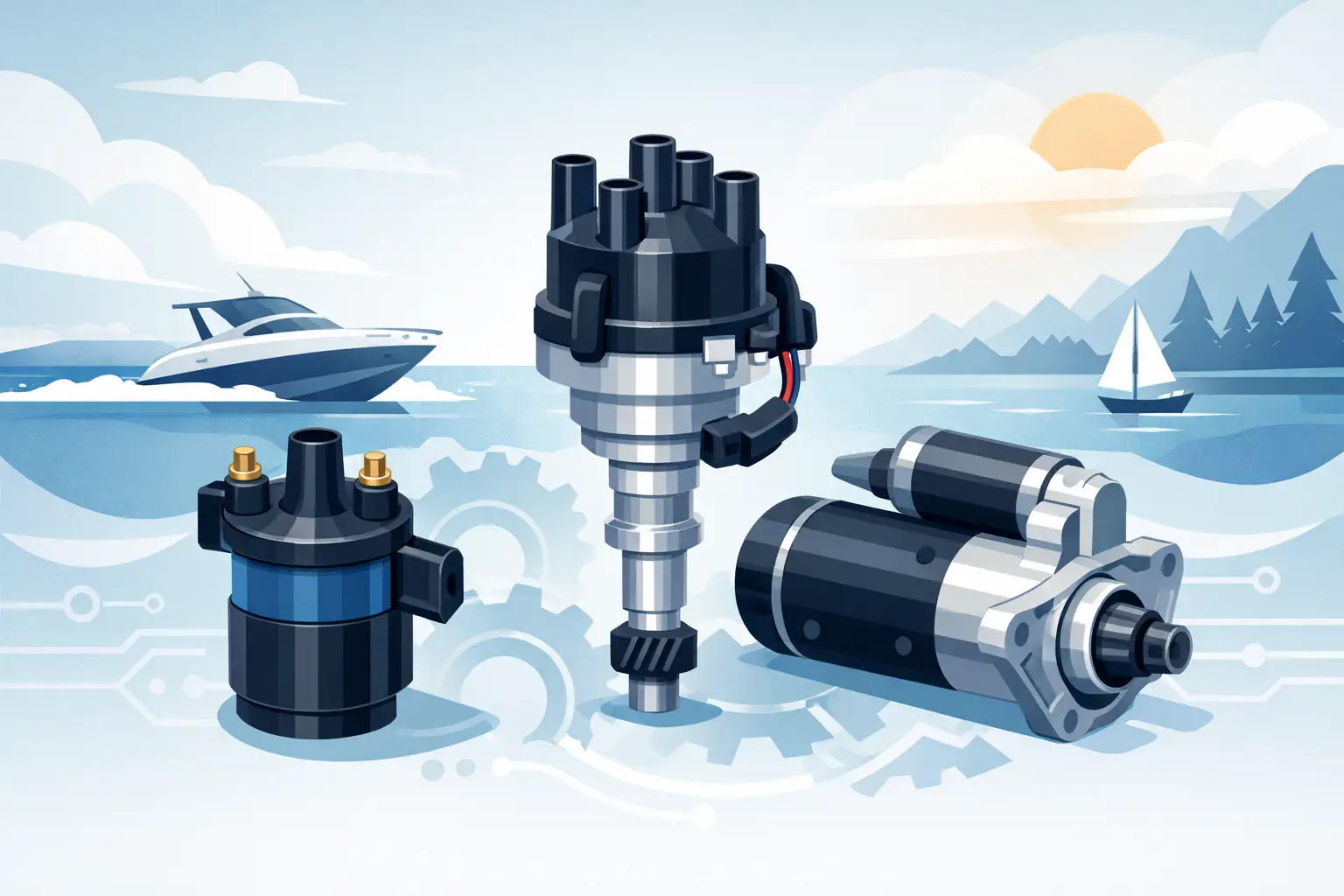
Sierra 18-5512, 18-5513 and 18-5514
If you're searching for sierra 18-5512, 18-5513, and 18-5514, you're usually not just casually comparing. Often there's already a problem on board, rough running, cutting out under load, doubt about the correct replacement parts, or simply the wish to properly handle preventive maintenance. In that case, you don't want a generic story, but clarity on what these parts do, what to watch out for, and why choosing correctly really matters on a MerCruiser engine.
What Sierra 18-5512, 18-5513, and 18-5514 are really about
These Sierra references are often searched by boat owners and mechanics who want to restore an existing ignition or tuning situation without unnecessary guesswork. Sierra is in practice a popular aftermarket brand for marine replacement parts, precisely because it offers an affordable alternative to original MerCruiser or Quicksilver parts for many applications.
With the numbers sierra 18-5512, 18-5513, and 18-5514, it's not just about whether a part fits mechanically. For ignition parts, it also matters whether the specification matches the distributor, the engine type, the model year, and sometimes even earlier modifications by a previous owner. On paper, a boat engine often looks standard. In reality, we regularly see combinations of original parts, aftermarket replacements, and later conversion kits.
That's exactly where the pitfall lies. Anyone who orders based on engine type alone can still end up with just the wrong variant. Especially on older MerCruiser configurations, a visual check is often just as important as the part number.
Why these parts are often looked at together
In the workshop, we see that customers often don't search for these three Sierra numbers separately. That's because they usually come up in the same repair or maintenance context. As soon as a distributor cap, rotor, or related ignition part shows wear, the overall condition of the ignition is often looked at more broadly.
That's wise. An engine that starts poorly or hesitates at certain rpm doesn't always have just one culprit. Contact problems, moisture, corrosion, hairline cracks, and incorrect fit reinforce each other. It then does little good to replace just one part if the rest of the system is near the end of its life.
For many boaters, the trade-off is simple. Do you just want to fix an acute problem to get back on the water, or do you want to make the ignition reliable again for the whole season right away? Both choices are defensible, but the second one often prevents extra downtime at an inconvenient moment.
Checking Sierra 18-5512, 18-5513, and 18-5514 for compatibility
The right match always starts with identification. Relying only on an old invoice or a vague engine description is risky. What you need is a combination of engine details and a physical check of the existing part.
First look at the exact MerCruiser engine block and, if relevant, the type of ignition system. A 4-cylinder, V6, or V8 can look related in terms of family but still use different parts. After that, it's smart to compare the old part on shape, mounting, connections, and dimensions. For ignition parts, the details are small but decisive.
Also pay attention to the engine's history. Older boats have regularly been modified with non-original distributors or conversion kits. In that case, a part that should fit according to the original engine list may in practice not be usable. That's not an exception, but something we come across regularly.
Details you'd better check beforehand
It helps to have the following information ready before ordering: the engine's serial number, the type of distributor, clear photos of the existing part, and preferably also an image of the mounting position. That makes the chance of ordering wrong much smaller.
If in doubt, comparing by photo is often faster than a long search through separate lists. Precisely because there have been so many variants and replacements over the years, visual material often gives an immediate answer.
Aftermarket or original - what's the wise choice here?
For many customers, Sierra is a logical option because price and availability are often favourable. Especially for regular maintenance or on an older boat, original doesn't always have to be the only right choice. A good aftermarket solution can work perfectly well, provided the application is correct.
Still, cheap isn't automatically advantageous. If a boat is used intensively, if maximum operational reliability matters, or if you've already had ignition faults, an original version or a proven quality replacement can be the better decision. That depends on use, budget, and the condition of the rest of the system.
For a recreational boat that's well maintained, Sierra is often a fine choice. For an engine with a questionable history, or a boat you want to take on holiday without surprises, it pays to look beyond just the lowest price.
Common mistakes when ordering Sierra 18-5512, 18-5513, and 18-5514
The biggest mistake is assuming that part number and application always match one-to-one without extra checking. That seems to save time, but actually causes delays. A second common mistake is only replacing the faulty part while the rest is visibly worn.
We also often see people only ordering once the boat is already out of action. In peak season, that creates unnecessary pressure. For ignition system parts, preventive replacement is often smarter than waiting for failure. Especially if you notice starting is getting harder, the engine runs unevenly, or there are visible signs of moisture and corrosion.
Another mistake is ignoring the mounting condition. Even the right part performs poorly if connections are oxidised, cables are damaged, or the distributor itself is worn. Anyone who only addresses the visible problem sometimes misses the real cause.
When replacement is genuinely necessary
Not every part needs immediate preventive renewal, but there are clear signs where waiting becomes unwise. Think of cracks, discolouration from heat, corrosion on contact points, moisture traces, or an engine that runs unevenly especially cold or especially warm.
On boats that have sat idle for a long time, for example after winter storage, there's something extra to consider. Condensation, material ageing, and inactivity can worsen ignition problems. In that case it's wise not just to test, but also to critically look at the condition of adjacent parts.
If you've already had multiple unexplained misfires or starting faults, replacing is often cheaper than continuing to search while the problem keeps coming back. In cases like that, targeted renewal of the suspect parts is usually the most practical route.
Fit it yourself or have it checked
For the handy DIYer, replacing this type of part is often manageable, provided you work carefully and document the starting position. Take photos beforehand, mark the cable order, and after installation calmly check that everything is exactly back where it should be. Small mistakes in the ignition quickly cause big complaints in engine running.
Still, doing it yourself isn't always the best choice. If you're unsure about timing, distributor type, or earlier modifications, a check by a specialist is wiser. That prevents a simple replacement from ending up with an engine that won't start or keeps running poorly.
For customers looking for both parts and technical support, that's exactly where a specialised supplier makes the difference. Not just supplying what's in stock, but also thinking along based on engine details, photos, and practical experience with the boat itself.
Practical advice when ordering
Don't order these parts by feel. First check the current situation on board, especially if you haven't owned the boat from new. A previous owner may have modified more than you think.
Also work with a complete diagnosis rather than isolated assumptions. If you're already doing ignition maintenance, check the condition of cables, spark plugs, connections, and any moisture problems around the distributor at the same time. That prevents a new set of parts from only temporarily masking the old fault.
At mercruiser-onderdelen.com, we notice every day that customers are helped fastest when they send along an engine number and photos right away. That saves back-and-forth searching and increases the chance you have the right part on the workbench in one go.
The right choice is usually the one that prevents downtime
With sierra 18-5512, 18-5513, and 18-5514, it ultimately isn't about a list of numbers, but about reliability on the water. The best order isn't necessarily the cheapest or the fastest, but the one that fits your engine, your use, and the actual condition of the ignition. If you take a close look at that before ordering, you usually prevent exactly the kind of fault that shows up at the wrong moment.


