

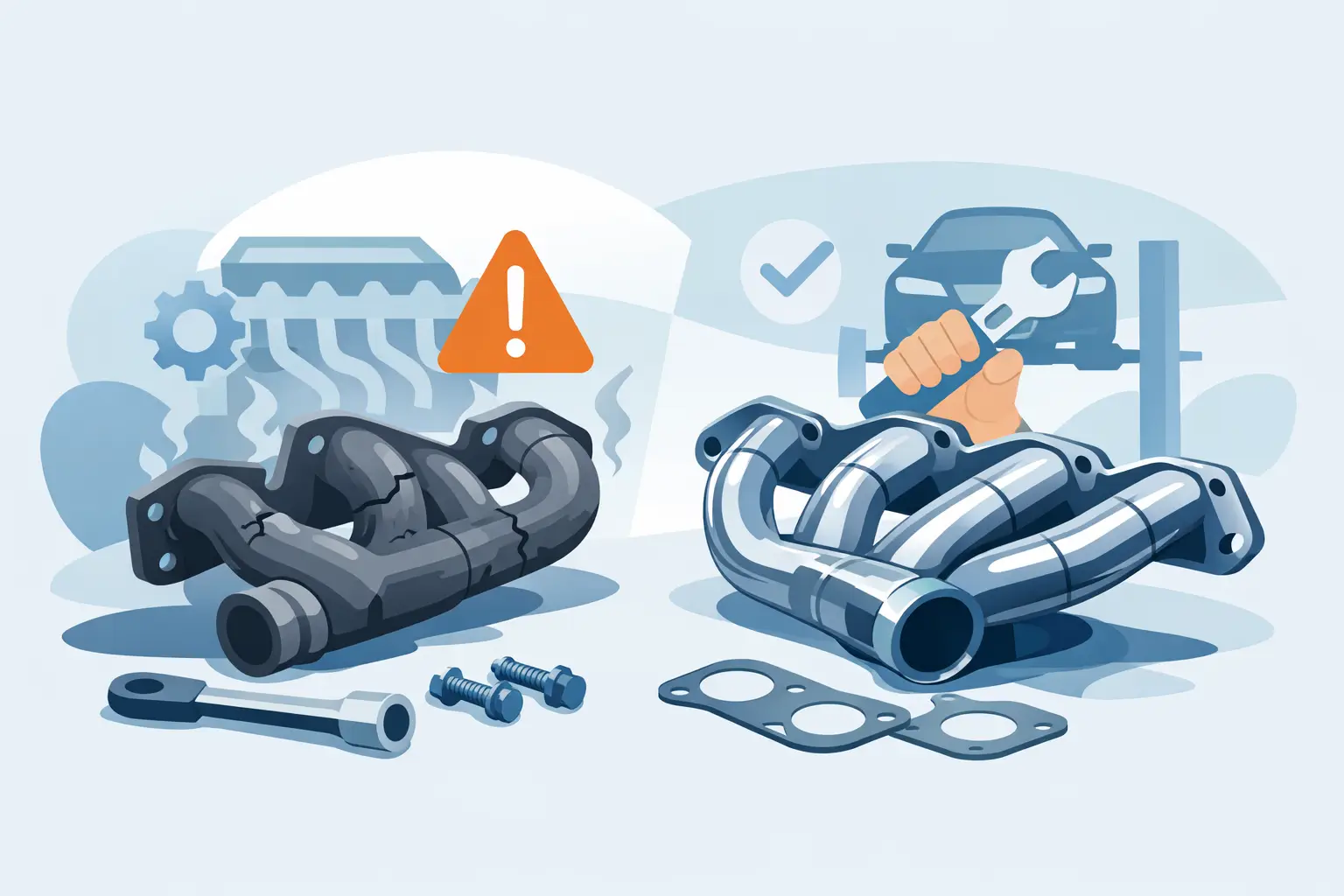
When to Replace Exhaust Manifolds
A MerCruiser that starts fine but suddenly sounds different, runs a bit hotter, or gets water where it shouldn't calls for quick attention. That's exactly when the question comes up: when to replace exhaust manifolds? On a boat engine, that's not a minor part, but a crucial point in cooling, exhaust gas removal, and engine protection.
With cars, you can sometimes keep driving a bit longer with a small crack or rust spot. In boating, it's different. Exhaust manifolds and risers operate in a wet, salty, or brackish environment, with large temperature swings and internal corrosion you can't fully see from the outside. Waiting until things really go wrong often makes the repair far more expensive than simply replacing the manifolds.
When to replace exhaust manifolds on a boat engine
The short answer is: replace exhaust manifolds as soon as there are signs of internal corrosion, leakage, cracking, reduced flow, or when age and usage conditions clearly warrant it. So there's no magic fixed moment that's the same for every engine.
In freshwater use, manifolds often last longer than in salt or brackish water. It also matters whether the engine has been properly winterized, whether it's sat idle a lot, and whether the cooling system has been well maintained. A boat that runs few hours can still have poor manifolds if a lot of internal corrosion has developed.
For many MerCruiser applications, preventive inspection becomes wise after just a few seasons, and with saltwater use, timely replacement is often more the rule than the exception. Anyone waiting for a clear fault is sometimes already too late.
Why exhaust manifolds wear out
A marine manifold has a hard job. On one side run hot exhaust gases, on the other side runs coolant. Inside, deposits, rust, and material loss build up. That process happens faster in salt water, but corrosion doesn't stop on its own in fresh water either.
The biggest problem is that wear usually starts from the inside. The outside can still look reasonably fine while the coolant passages are already clogged, or the material has become so thin that water can leak in the wrong direction. At that point you're no longer talking about a small exhaust issue, but about the risk of water damage to cylinders, valves, or even complete engine failure.
On V6 and V8 engines with MerCruiser configurations, we often see in practice that manifolds and risers need to be assessed together. Replacing one part while the other is already internally poor rarely gives a lasting solution.
Signs that replacement is wise
One of the first clues is an unusual engine sound. A leaking manifold gasket or a crack can cause a louder, sharper, or ticking exhaust sound. Sometimes you also smell more exhaust in the engine bay.
Temperature is also an important clue. Poor flow in the manifold or riser can cause localised overheating. Not every engine gives a clear alarm right away, but rising temperature, uneven heat distribution, or recurring heat problems always deserve investigation.
Another serious sign is moisture or rust traces around the connection of the manifold, riser, or elbow. If you see salt crystals, rust streaks, water leakage, or discolouration around gaskets and mating surfaces, don't assume it's cosmetic.
It becomes even more serious with starting problems, uneven running, or water in the cylinders. If water gets back into the engine via an internally rusted-through manifold or riser, that can lead to hydro-lock, bent connecting rods, poor compression, or bearing damage. At that point you're well beyond normal maintenance.
How long do exhaust manifolds last?
There's no fair universal number for that. In fresh water, some sets reach a fairly long lifespan. In salt or brackish water, replacement can be needed much sooner, sometimes after just a few years. Usage pattern also matters. Many short runs, long periods of inactivity, and inadequate flushing after use speed up deterioration.
Anyone buying a boat second-hand does well not to rely blindly on hours alone. An engine with few running hours but an unknown maintenance history can carry more risk on this point than an intensively used engine whose manifolds and risers have demonstrably been replaced recently.
If in doubt, age alone is often reason enough for a targeted inspection. Especially if there are no invoices or serial number information available about a previous replacement.
Inspect or replace right away?
That depends on the condition, the application, and the risk you're willing to take. A visual check from the outside helps, but isn't enough. Parts often need to be removed to assess the mating surface, the water passages, and the internal condition.
Sometimes a manifold is still usable and mainly the riser is affected. Sometimes it turns out both parts are near the end of their lifespan together. In practice, partial replacement only makes sense if the rest is demonstrably good. Otherwise you're just pushing the problem forward and will later pay again for labour, gaskets, and downtime.
For boats that need to be reliably available during the season, preventive replacement is often the wisest choice. That applies even more strongly for performance use or longer trips, where you don't want breakdowns on the water or consequential engine damage.
OEM or aftermarket manifolds?
That's not a black-and-white choice either. Original MerCruiser and Quicksilver parts often offer the certainty of known fit and specification. Good aftermarket alternatives can be appealing when price, availability, or older engine applications play a role.
More important than price alone is that the part fits exactly to your engine variant, cooling system, and exhaust configuration. An incorrect height, wrong water passage, or deviating connection can cause installation problems or functional risks. That's why it pays to look at engine type, serial number, and complete set-up rather than just how a part looks at first glance.
When you shouldn't wait any longer
There are situations where postponing simply isn't a good idea anymore. That's the case with visible leakage, repeated overheating, rusty water around the exhaust parts, suspected internal water leakage, or if the manifold has already been removed and turns out to be clearly worn or rusted through.
Also, if you're winterizing the boat and the exhaust parts are old with an unclear history, that's often exactly the moment to take action. You prevent being stuck again at the start of the next season, or worse, damaging the engine after the first start.
For engines with a known saltwater history, caution isn't an unnecessary luxury. In many cases, the cost of replacement doesn't outweigh the damage from water ingress into the block.
When to replace exhaust manifolds and risers together
We get this question a lot, and the answer is usually: yes, assess together and often replace together too. The parts work as one system. If a new manifold is combined with an old, internally deteriorated riser, the weak point remains.
You're also dealing with gaskets, bolts, sealing surfaces, and flow. A complete approach usually gives more reliability and less chance of recurring complaints. That's especially relevant on MerCruiser V6 and V8 engines, where exhaust problems can quickly affect overall engine health.
Practical advice for boat owners
Don't wait for absolute certainty if you're already seeing multiple signs. A combination of age, saltwater use, questionable maintenance history, and early complaints is often enough to seriously plan for replacement.
Don't be reassured by a neat exterior alone. The real wear is often on the inside. Anyone working on it themselves does well, during disassembly, to look not just for rust, but also for passage narrowing, pitting corrosion, gasket surfaces, and traces of water where it shouldn't be.
If you mainly use the boat recreationally and just want to sail without hassle, preventive maintenance is often cheaper here than reactive repair. If you use the boat sportily or under higher load, that applies even more strongly.
When choosing replacement parts, correct identification is essential. Think of engine type, model year, serial number, cooling, and the complete exhaust build-up. Anyone unsure about this is better off having it properly identified first. That prevents returns, wasted installation effort, and unnecessary downtime. At mercruiser-onderdelen.com, we regularly see that customers mainly lose time because they ordered by feel instead of by exact application.
If you're unsure when to replace exhaust manifolds, the rule of thumb is simple: better to replace them one season too early than an engine too late. A well-fitting manifold costs money, but a seized or water-damaged engine costs a lot more, and above all, boating enjoyment during peak season.


