

When to Replace MerCruiser Bellows
A bellows that still looks fine on the outside can already be torn on the inside. That's exactly why the question of when to replace MerCruiser bellows matters so much. Wait too long, and water gets free access to your sterndrive, U-joint, or cable pass-through, turning a relatively normal maintenance job into costly consequential damage.
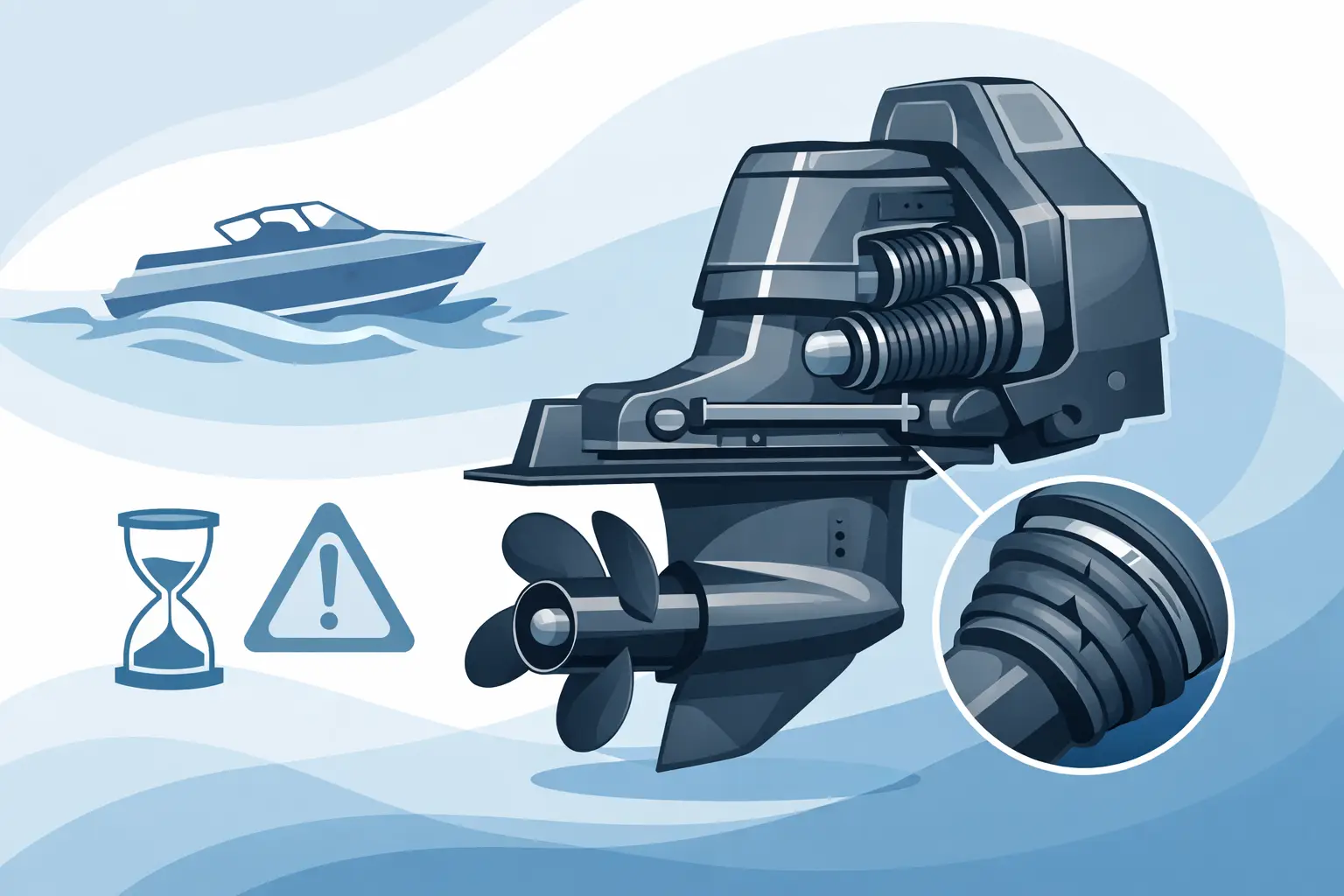
With MerCruiser, this usually involves several bellows around the sterndrive. Think of the U-joint bellows, the exhaust bellows, and on many set-ups also the shift cable bellows. Not every bellows has the same function or the same risk. The U-joint bellows in particular is critical, since leakage there can directly affect bearings, U-joints, and the entire drivetrain.
When replacing MerCruiser bellows is genuinely necessary
The short answer is simple: replace bellows as soon as cracks, drying out, deformation, or leakage are visible. In practice, it's wiser not to rely on looks alone. Rubber parts also age when the boat sails little. Sun, inactivity, temperature swings, and mounting angle all play a role.
For normal recreational use, many mechanics use roughly 5 years as a safe guideline for inspection, with replacement as soon as doubt arises. With intensive use, a lot of trailer transport, a lot of salt water, or prolonged outdoor storage, that can be sooner. Some installations last longer, but that's no reason to postpone maintenance. Bellows rarely fail at a convenient time.
Anyone asking when to replace MerCruiser bellows is often really asking: do I replace preventively or only once there's damage? Our practical answer is usually preventively, especially with an unknown maintenance history. If you're not sure how old the bellows are, replacing is often cheaper than guessing.
Which bellows need the most attention?
U-joint bellows
This is the most important one. This bellows keeps water away from the U-joints and the gimbal bearing zone. A small crack can already be enough to let moisture in. You don't always notice that immediately while boating. Sometimes problems only show up during disassembly, when rust, water residue, or worn bearings become visible.
Shift cable bellows
This smaller bellows is often overlooked. Yet leakage can specifically develop here as the rubber ages or through movement around the shift cable. Because this part draws less attention, damage is sometimes discovered late.
Exhaust bellows
The exhaust bellows is technically less critical for the watertightness of the drivetrain than the U-joint bellows. Still, it deserves attention too. It takes a lot of punishment from heat, movement, and age. Depending on the configuration, some owners choose an exhaust tube instead of a full bellows, but that depends on the drive type and use.
Signs that replacement can't wait any longer
A bellows doesn't need to be completely torn through to be a problem. Small drying cracks in the folds are often the beginning. If you see crazing, loose edges, porous rubber, or greasiness combined with dirt buildup, that's reason for further inspection.
Other signs are water in the bellows cavity, rust traces near the U-joints, a humming or grinding noise from the gimbal zone, or a noticeably heavier-feeling drive when steering and trimming. A bellows that's become hard or no longer holds its shape well is also usually near the end of its lifespan.
Buying a used boat with a MerCruiser drive and there's no invoice or maintenance record of a recent bellows replacement? Then inspection isn't a luxury. That's especially true for Alpha One and Bravo drives that have already run several seasons without demonstrable sterndrive maintenance.
Age or hours - which tells you more?
With engine maintenance, you often look at running hours, but with bellows, age is usually more important. A boat with few hours can actually suffer extra from dried-out rubber due to inactivity. A boat used every season and stored properly indoors can sometimes have better bellows than an idle boat sitting outside under a cover.
That's why a fixed hour limit works less well here. The combination of age, storage, water use, and visible condition gives a more reliable picture. For many boat owners, a check during winter maintenance or pre-season inspection is the most logical moment. That lets you address problems before the boat goes back in the water.
Why postponing often ends up more expensive
Replacing bellows sometimes feels like deferred maintenance because the part itself isn't always spectacularly expensive, but the installation does take work. Still, the real cost usually lies in what happens if you wait too long. Water at the U-joints or the gimbal bearing causes wear that a new bellows alone won't fix.
Then you're suddenly talking about extra parts, more labour, and in some cases downtime right in the middle of the season. Especially in summer, you don't want a boat on land because of something that could easily have been planned in winter or spring.
That's also the practical difference between reactive and preventive maintenance. Reactive sometimes seems cheaper, until more turns out to be broken than expected.
Check it yourself or have it done?
A first visual check is perfectly manageable yourself if you have some technical basics. Look at the folds of the rubber, feel whether the material stays supple, and check for traces of water or rust. Also check that no clamps are loose and that the bellows stays properly in position at different trim angles.
But a full assessment often requires more than a quick look from the outside. Some damage only becomes clearly visible once the drive is removed. That's especially relevant if you're unsure about the U-joint bellows. A superficial inspection can give a false sense of security.
For handy DIYers, replacing it yourself is possible, but only with the correct parts, mounting order, and alignment. Incorrectly fitted bellows leak or wear faster. Fit also differs per MerCruiser configuration, such as Alpha One Gen 1, Gen 2, or Bravo. Choosing the correct part therefore matters just as much as the installation itself.
OEM or aftermarket bellows?
There's nuance here. Original MerCruiser or Quicksilver bellows often offer the most certainty in fit and material quality. Good aftermarket alternatives can be appealing if price plays a role, but then the quality really needs to be right. With bellows, you don't want a questionable rubber compound or a mediocre fit, since that's exactly what causes leakage and premature wear.
For customers who don't exactly know which sterndrive or model year they have, part identification is often the biggest hurdle. In that case, it's smarter to first check the serial number or drive type than to order by feel. A bellows set that doesn't quite match ultimately costs more time and money.
Combining bellows replacement with other maintenance
If the drive is coming off anyway, it's smart to look beyond just the rubber. This is a logical moment to also check the gimbal bearing, U-joints, alignment, and shift cable area. It often pays to bundle maintenance, especially if the drive is already removed.
During winterizing or major sterndrive maintenance, you therefore regularly see bellows replacement being part of a broader service. That prevents double work and reduces the chance you have to disassemble again shortly after installation for another worn part.
When to replace MerCruiser bellows in doubtful cases?
Doubt in this maintenance job is usually already a signal. Do you see early cracks, don't know the age, or has the boat sat idle for years? Then replacing is usually the safest choice. Not because every old bellows will crack tomorrow, but because the consequences of one leaking U-joint bellows can simply be too significant.
For boats that spend a lot of time in salt water, I'd wait even less. Salt, heat, and inactivity together aren't a good combination for rubber and metal parts around the drive. There, preventive replacement is often cheaper than later renewing bearings, U-joints, and additional seals.
This is also a point worth taking seriously during purchase inspections of used speedboats or motorboats with a MerCruiser drive. A tidy-looking engine says little if the bellows are at the end of their life.
Practical advice for the right timing
The best time to replace bellows is before the season, during winter maintenance, or as soon as inspection raises doubt. Don't wait for visible leakage out on the water. By then you're already too late. Better to plan this maintenance at a time when parts are available and there's room to calmly look at everything around the sterndrive.
Have an Alpha One or Bravo drive and aren't sure which bellows set fits? Have it properly identified first. At Mercruiser-onderdelen.com, we see every day that correct identification prevents a lot of hassle, especially on boats with an unclear maintenance history.
Anyone who wants their boat reliably ready for the season does well not to treat bellows as a minor detail. It's exactly the kind of part you'd rather replace before it demands attention.


