

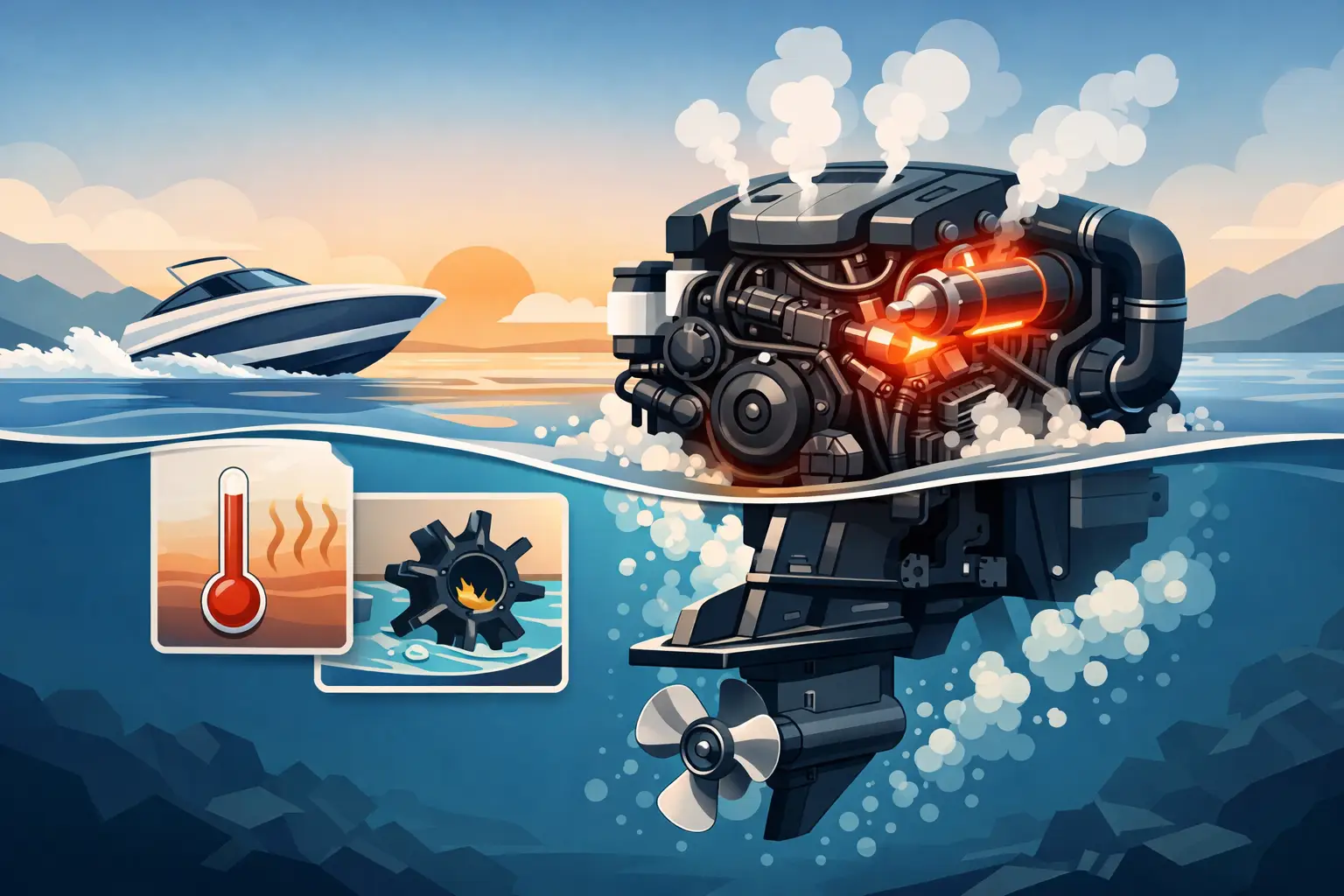
Why a MerCruiser Engine Overheats
A MerCruiser that suddenly runs hotter than normal isn't something you can shrug off for another day out on the water. Certainly not if the temperature gauge climbs quickly, the alarm goes off, or less cooling water comes out of the exhaust. Anyone who wants to understand why a MerCruiser engine overheats should almost always start with the cooling system, and only then look further into the less obvious causes.
Why a MerCruiser engine overheats: it usually starts with the water flow
On a MerCruiser, overheating is rarely a mystery. In practice, it's often a disruption in the supply, circulation, or discharge of coolant. That can be something simple, like a worn impeller, but also a combination of small faults that together push the temperature up.
The first question is always: is the engine really running too hot, or is the gauge giving a false picture? A faulty temperature sensor, a poor earth connection, or a fault in the gauge can send you down the wrong path. Still, the same rule usually applies in the workshop: assume a genuine cooling problem first until proven otherwise. Engine damage from continuing to sail too long is more expensive than one extra check.
The impeller is often the first suspect
On MerCruiser engines with a sterndrive, the impeller is one of the most common causes of overheating. This impeller draws in outside water and moves it through the cooling system. If the impeller is worn, dried out, cracked, or partially broken, water output drops right away.
You don't always notice that immediately at idle. Some engines still stay reasonably cool in the marina, but quickly run too hot under load or at higher rpm. That's a classic sign of an impeller that's still doing something, but not enough anymore.
A second problem is that broken-off impeller fragments get stuck further along in the system. In that case, you replace the impeller, but flow remains restricted by rubber pieces in a hose, oil cooler, or thermostat housing. That's exactly why a quick replacement alone isn't always sufficient.
Blockage in the water intake, hoses, or cooler
A MerCruiser draws coolant from outside. That also means outside debris can get in. Plastic, water plants, small shells, mud, or salt deposits can restrict the water intake. With use in brackish or salt water, we also more often see narrowing in coolant passages and heat exchangers.
The hoses themselves also deserve attention. An old hose can delaminate internally or partially collapse under vacuum. On the outside, such a hose can still look usable, but water flow is restricted. The same applies to a clogged oil cooler or power steering cooler, where small impeller fragments or debris tend to collect.
With closed cooling systems, there's an extra layer on top of that. Not only does the raw water side need to be in order, but so does the circulation of coolant in the internal circuit. A shortage of coolant, air in the system, or a contaminated heat exchanger can then be the cause.
Thermostat and circulation pump: small part, big effect
A thermostat that no longer opens properly quickly causes rising engine temperatures. That happens especially when the engine seems to warm up normally at first and then overshoots past operating value. Sometimes the thermostat sticks partially, so the problem comes and goes. That makes diagnosis trickier.
The circulation pump on the engine side is also regularly overlooked. Where the impeller supplies the outside water, the circulation pump provides flow through the engine block. If that pump is worn, has a damaged impeller, or shows play on the shaft, coolant may not be pumped around sufficiently internally.
The distinction between these two pumps matters. Many boat owners replace the impeller while the real problem sits further along. The reverse also happens: people suspect the thermostat, while the water supply is already falling short before the water even reaches the block.
Why a MerCruiser engine overheats under load but not at idle
This is a situation we hear often: everything seems fine in the marina, but as soon as the boat gets on plane or runs at speed for a longer period, the temperature climbs. In that case, there's a good chance the system just about copes with low demand, but falls short under higher load.
That often points to an impeller problem, a partial blockage, or a restriction in the water intake. The exhaust side can play a role too. On some MerCruiser configurations, a problem in the risers or manifolds leads to poorer heat dissipation. Internal corrosion then narrows the passages, so the cooling water doesn't do its job as well.
We see this regularly on older V6 and V8 engines. Especially when manifold and riser maintenance has been postponed, the risk of overheating increases. That said, not every warm-running engine automatically has bad manifolds, but with age, saltwater use, and an unknown maintenance history, you should seriously factor in that possibility.
Exhaust parts, manifolds, and risers are often checked too late
Many owners think of the pump first when it comes to overheating, and only much later of the exhaust side. That's understandable, but not always justified. Manifolds and risers are wear parts, especially in salt or brackish water. Internal corrosion narrows the water passages and disrupts coolant distribution.
The tricky part is that this process happens from the inside. On the outside, the part can still look acceptable, while flow is already significantly restricted internally. In some cases, that not only causes overheating, but also the risk of more serious engine damage when water ends up in the wrong place.
That's why preventive inspection here isn't an unnecessary luxury. Anyone who only does oil, filters, and the impeller every year, but never assesses the exhaust cooling, misses an important part of the system.
Sensor, gauge, or genuinely too hot?
Not every high temperature reading means the engine is genuinely overheating. A faulty sensor, corroded connector, poor wiring, or an incorrect gauge can cause a false alarm. Still, you need to properly figure out that distinction rather than guess.
If the engine clearly feels hotter than normal, you smell warm rubber, the alarm sounds convincing, and the cooling water discharge decreases, there's a good chance of a genuine problem. If you only have an erratic gauge with no other symptoms, an electrical measurement issue could be involved. Both situations call for a check, but the follow-up differs.
What to check immediately if the engine runs too hot
Don't keep the engine under load unnecessarily long. First check whether enough cooling water is coming out of the exhaust. Then look at the water intake, the condition of the impeller, and any visible kinks or leaks in the hoses.
Also check the oil level and, with a closed system, the coolant level. Look for traces of salt, rust, or dried-up leakage around the thermostat housing, hose connections, and heat exchanger. If the impeller recently failed, don't assume replacement alone is enough, the loose fragments often need to be retrieved from the system.
Don't keep restarting in the hope it'll sort itself out. That rarely happens. What does happen is further damage to the impeller, exhaust parts, head gaskets, or, worst case, the engine itself.
What we see most often in practice
With MerCruiser engines, overheating usually comes down to deferred maintenance, wear, or a part that's already been underperforming for a while. An impeller that just went one season too long. A thermostat that no longer opens reliably. A cooler with debris stuck inside. Or manifolds and risers clogging up internally without it being immediately obvious.
That's also where the nuance lies. There isn't always one clear culprit. Sometimes the impeller is weak, the thermostat sluggish, and the exhaust internally contaminated. In that case, replacing just one part only half-solves the problem. That's exactly why systematic checking works better than randomly swapping parts.
For boat owners who work on their own boats, that's good news and bad news at the same time. The good news is that many causes can be found technically well enough. The tricky part is that you need to cover the whole cooling path, from water intake to exhaust. If there's doubt about that, it's wiser to compare parts in a targeted way or have someone take a quick technical look. At mercruiser-onderdelen.com, we help with that every day in practice, precisely because downtime during the season quickly becomes annoying and costly.
Prevention is easier than repairing an overheated engine
The best approach is still preventive maintenance at the right time. Replacing the impeller on schedule, checking the thermostat and hoses, keeping coolant passages clean, and not endlessly reusing exhaust parts saves a lot of hassle. Especially on boats with an unclear maintenance history, it pays to first get the basics of the cooling system in order.
If you boat in salt or brackish water, you need to be even more alert. Corrosion, deposits, and internal narrowing simply happen faster there. And if you use the boat rarely, different problems arise, such as rubber parts drying out and components seizing.
A MerCruiser that's getting too hot usually gives early signals. Anyone who takes those signals seriously and looks at cooling as a complete system usually prevents bigger damage and unnecessary downtime right at the moment they want to head out on the water.


