

Alpha One Gimbal Bearing Guide
A knocking sound while steering, vibration in the transom, or a grinding feeling as soon as the drive turns, that often leads you to the bearing housing faster than you'd like. This Alpha One gimbal bearing guide is written for boat owners and mechanics who don't want to guess, but want to know what to look for, what can go wrong, and when replacing is wiser than continuing to sail.
What a gimbal bearing on an Alpha One actually does
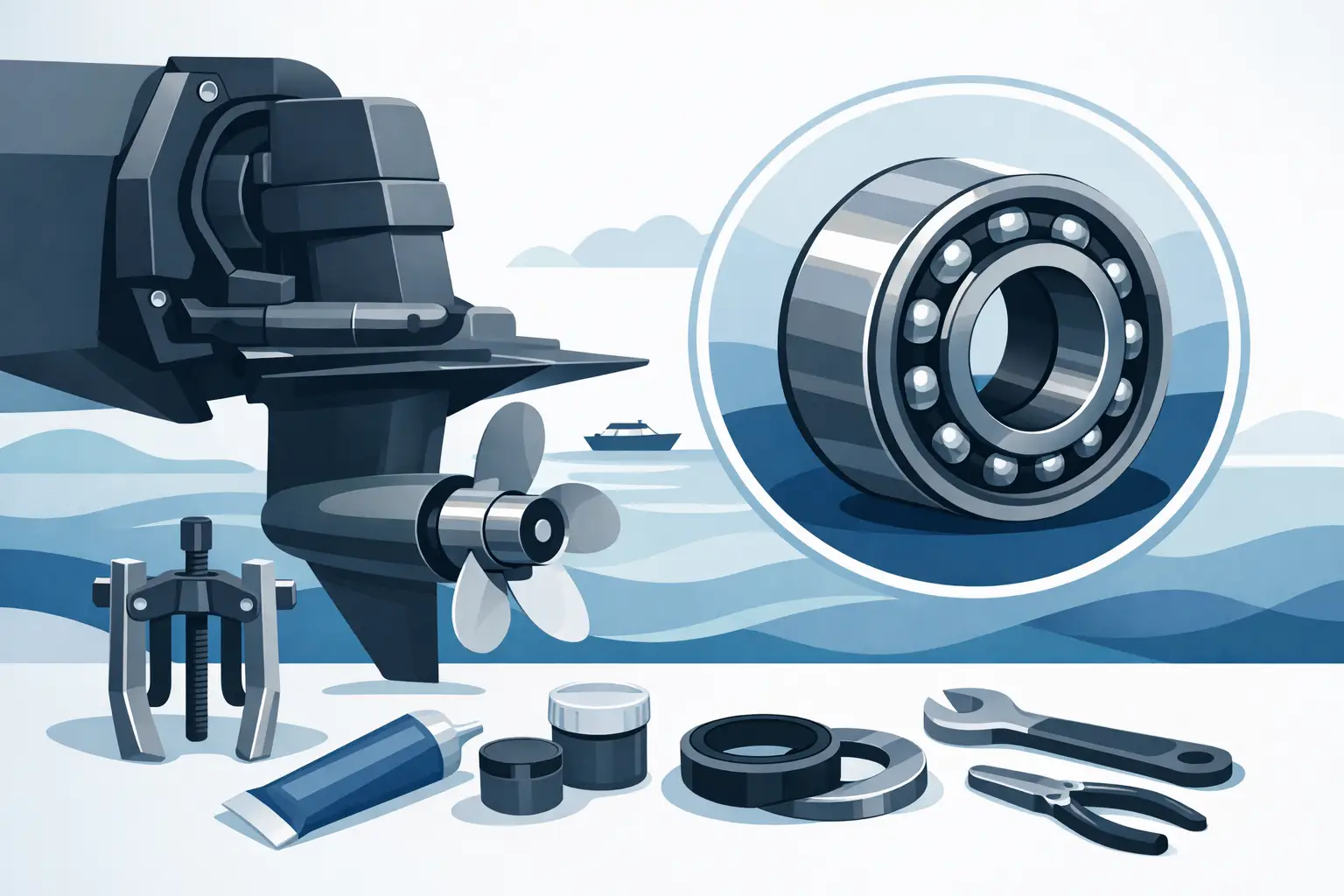
The gimbal bearing supports the input shaft of the sterndrive at the point where the drive passes through the transom. On a MerCruiser Alpha One, that's not a minor part, but a crucial link between the engine and the sterndrive. If this bearing doesn't run properly, you don't just get noise and vibration, but also extra load on the coupling, U-joints, and input shaft.
In practice, we see a worn gimbal bearing often noticed too late. Many owners first think of a problem in the U-joints or in the drive itself. That's understandable, since the complaints overlap. Still, the distinction matters: a bad bearing can sometimes still be fixed relatively simply, while continuing to sail makes the damage bigger and more expensive.
Complaints that fit a worn gimbal bearing
A faulty gimbal bearing rarely shows itself in just one way. Sometimes you hear a rough, growling noise idling in gear. Sometimes you only notice it while steering or under load. And sometimes the boat just feels "less tight" in the drivetrain.
Familiar signs are humming or grinding from the transom, a metallic sound when turning the wheel or the drive, vibration that increases with rpm, and play or stiffness when the drive is removed and you check by hand. Water ingress often plays a role too. If the bellows is faulty or doesn't seal properly, the bearing takes on moisture. Then wear happens fast.
That doesn't mean every noise is immediately the gimbal bearing. A U-joint can produce similar complaints, as can a misaligned engine or damage to the input shaft. That's exactly why a proper diagnosis pays off.
Alpha One gimbal bearing guide for diagnosis
The first step is always to look at the whole system around the transom plate. A gimbal bearing rarely just fails without a cause. So check not just the bearing itself, but also the bellows, the alignment of engine and drive, the condition of the U-joints, and any traces of rust or water.
Once the sterndrive is removed, you can assess the bearing by hand. It should turn smoothly, without a scraping feeling, without catching, and without noticeable play. If you hear a dry, rough, or gritty sound, that's usually already enough reason to go beyond just cleaning or re-greasing.
Another important check is engine alignment. On an Alpha One, a bearing can wear prematurely if the engine isn't correctly aligned with the drive. You don't always see that directly from the outside. You often only notice it during installation or when an alignment tool doesn't slide smoothly into position. Many replacements fail not because of the part, but because of an underlying alignment error that wasn't corrected.
When replacing is the right choice
There are cases where a bearing still looks usable, but is nevertheless better replaced. For example, if the drive is already off for bigger maintenance, if there's been water in the bellows, or if you see clear rust traces. The part itself usually isn't the most expensive item in the repair. Labour, disassembly, and consequential damage often make postponing more expensive.
If in doubt, a practical rule usually applies: if the bearing runs rough, makes noise, or has shown signs of moisture, replace it. Especially during the boating season, you don't want to put a boat back in the water with a part you already know is on the edge.
For intensively used boats, sporty applications, and heavier V6 or V8 configurations, that trade-off is even clearer. Extra load means less margin. In that case, preventive replacement is often wiser than waiting until the complaints become severe.
Difference between OEM and aftermarket
Not every customer makes the same choice, and that's fine. For an Alpha One gimbal bearing, there are both original MerCruiser or Quicksilver solutions and aftermarket alternatives. What's wise depends on use, budget, and how long you want to keep sailing with the boat.
OEM is often the safe route if you want to match factory specification exactly and don't want any discussion about fit or material quality. Good aftermarket can, on the other hand, be a fine choice if it's a proven replacement part from a reliable manufacturer. The advantage usually lies in price. The downside is that there's also a quality difference in the market. A cheap bearing that seals poorly or runs less smoothly ultimately costs more if the drive has to come off again.
That's why choosing parts for this kind of work isn't just a matter of part number and price. Application and reliability count for more than they often seem to on paper.
Replacing a gimbal bearing - where it often goes wrong
Removing and fitting a gimbal bearing isn't a complicated operation for an experienced mechanic, but it's also not a job where you can afford to be careless. The bearing needs to be seated neatly and straight, the bore needs to be clean, and the fit mustn't get damaged. A bearing driven in at an angle causes immediate problems.
Just as important is what happens after installation. If the engine isn't aligned, the bellows doesn't seal properly, or the U-joints are already damaged, you only solve part of the problem. Then the boat comes back with noise or vibration again, while the new bearing wrongly gets the blame.
Lubrication also needs attention, but not every Alpha One system is identical in how maintenance is carried out. Model year and configuration matter. Blindly adding grease without knowing what the application needs isn't the same as proper maintenance. Here it applies: look at the exact set-up of the boat, not just a generic manual.
Which parts you should assess at the same time
If the sterndrive is off, it's rarely smart to only look at the gimbal bearing. This is the moment to assess several wear parts at once. Think of the gimbal bellows, shift cable bellows, exhaust bellows, U-joints, seals, and the general condition of the transom assembly.
That doesn't mean everything automatically needs replacing. But if a bellows is aged or torn, or if the U-joints already feel stiff, this is the moment to include that. Water in the bellows area in particular is a red flag. In that case, you need to look beyond just the bearing.
For customers who maintain their own boat, this is often the difference between one good repair and doing the same job twice in a short time. For work boats or boats that run a lot of hours, that's even more relevant.
Why correct fit and application matter
With MerCruiser parts, things often go wrong in the details. Alpha One Gen I and Gen II get mixed up, serial numbers aren't checked, or people order based on a photo instead of engine and drive details. For a gimbal bearing, you don't want to make that mistake.
Correct fit doesn't just determine whether the part physically fits, but also whether the entire drivetrain keeps functioning correctly. That's why it's wise to always order based on the exact drive version, and to include additional details where needed. Especially if a boat has been converted in the past, or already has aftermarket parts fitted.
A specialist with practical experience spots more quickly where things can go wrong. That saves time, returns, and downtime. For anyone looking for parts while also wanting technical guidance, that's often just as valuable as the stock itself.
DIY or outsource?
That depends on experience, tools, and how confident you are in the diagnosis. A handy owner can remove an Alpha One drive and carry out basic checks, but for properly removing, fitting, and aligning the bearing, good tools aren't a luxury. Without an alignment tool and without a feel for the condition of adjacent parts, it quickly becomes only half the job.
Outsourcing is often wiser if you can't quite place the noises, if the boat has multiple complaints at once, or if you already see traces of moisture and rust. In that case, it's better to have the system assessed as a whole. That prevents you from replacing individual parts while the real cause remains.
At mercruiser-onderdelen.com, we notice every day that customers are mainly looking for speed and certainty. Not just a matching part, but also the answer to whether that part actually solves the problem.
What to check after the repair
After replacement, the drive should run quiet, smooth, and without extra vibration. A short test paying attention to noise, shifting, and load often already tells you a lot. If you still hear humming or a grinding noise, don't assume the new bearing still needs to "bed in". In that case, the diagnosis needs to go back through the U-joints, alignment, and other rotating parts.
Also check that the bellows stays neatly dry and that no new traces of leakage appear. A perfectly fitted bearing won't last long if the surrounding seal isn't in order.
A gimbal bearing isn't a big part, but it does tell you a lot about the condition of the drivetrain. Anyone who looks at it in time usually prevents bigger damage and more downtime. And that's exactly where the gain lies: not waiting until it really goes wrong, but stepping in while the repair is still manageable.


